




HEALTHCARE DELIVERY ORGANIZATIONS
Secure the Software Behind Patient Care
When the software underpinning your infrastructure is compromised, the secrets, keys, and unpatched CVEs attackers exploit for ransomware put patient safety, clinical uptime, and regulatory standing at risk.
NetRise analyzes the compiled software across your medical devices, clinical systems, and the patient-facing apps your own teams build, so you can find risk that threatens patient care, address it, and prove compliance.
The Challenge
You Didn't Write Most of Your Clinical Software. You're Still Accountable for It.
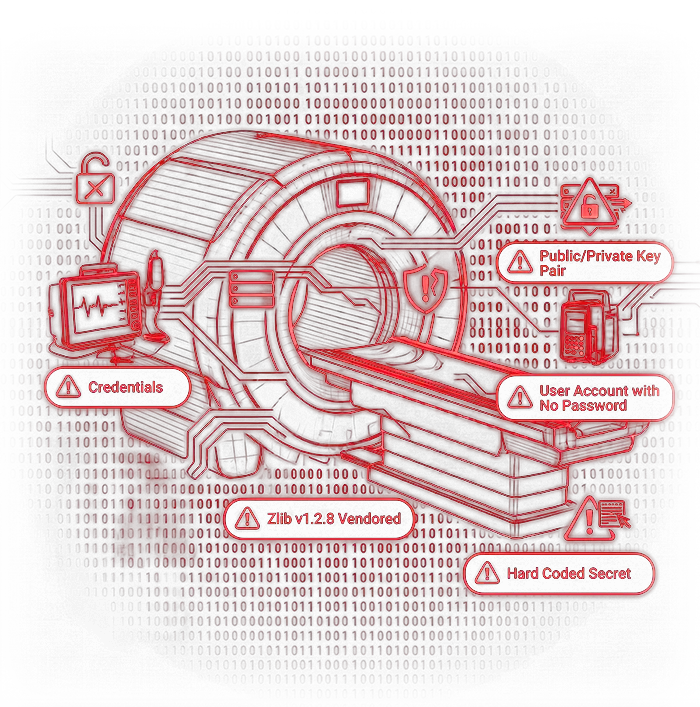
A medical device runs on open-source software (OSS), vendor firmware, and inherited operating systems, most written by someone else. The patient-facing apps your own teams build pull in open-source too. Accountability doesn't transfer with the code. When an assessor asks what is running inside a clinical system, the answer has to come from you.
Where Healthcare Security Tooling Stop Short
Vulnerability scanners
Discover a device's installed software and match it to known CVEs, but never unpack the compiled firmware where non-CVE risk hides.
Vendor Attestations & SBOMs
Reflect what a device maker chose to disclose, and go stale the moment the next firmware update ships.
Source-based Testing (SAST/SCA)
Analyzes the code a vendor wrote, not the compiled artifact that runs on the device, missing statically linked and embedded components.
Manual Incident Scoping
After a disclosure, finding the affected devices by hand can take weeks while the vulnerable systems keep running in patient care.
WITH NETRISE
Evidence Across the HDO Environment
NetRise Turbine® analyzes the compiled firmware inside your medical devices, IoMT, imaging systems, and hospital infrastructure, including the components below the application layer no manifest lists. Verification starts from what is actually there.
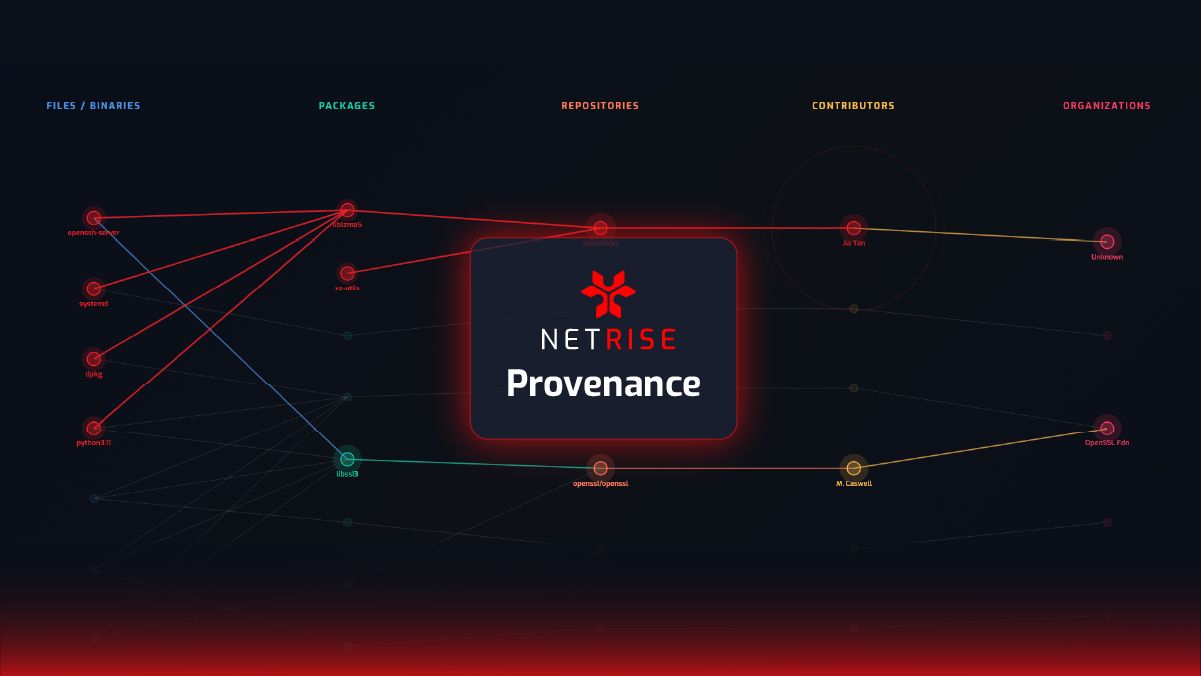
Turbine analyzes the software a device maker ships without relying on self-attestation or delayed disclosures. NetRise Provenance® evaluates the open-source components inside that firmware, so procurement decisions rest on evidence rather than checklists.
Not every finding is urgent. Turbine filters to the vulnerabilities that are reachable, autorun at startup, and known to be weaponized in ransomware, so remediation targets the risk most likely to disrupt clinical operations.
When the next Log4j-scale disclosure lands, Provenance traces how far the risk propagates across the libraries and vendors around it, and Turbine names the assets carrying the affected component. A multi-week hunt becomes a same-day answer.
For the patient-facing apps and clinical software your teams ship, Turbine generates a build-true SBOM from the compiled application and catches the open-source risk source testing misses, so you can prove what ships before it goes live.
THE SOLUTION
Two Products. One Complete Answer.
Every clinical device runs on code your teams didn't write. Turbine opens the compiled software to confirm what's actually there, no source needed. Provenance judges whether the open-source inside it can be trusted, and when one is compromised, shows which upstream components inherit it. One answer, built from the software itself — not a vendor's word for it.
A finding isn't the same as a threat.
Most vulnerabilities in a medical device never execute. Turbine traces which a running entry point can actually reach, so your team spends its time on the flaws that can be turned against a patient-facing system, not the thousands sitting dormant.
- Present — the vulnerable component ships inside the device.
- Reachable — something can actually get to it; a live path connects it to an entry point, so it's exploitable, not just resident.
What that surfaces in real device software:
- 2400+vulnerabilities in a brand-new XIoT device a network scanner reports clean
- 6of them on the KEV list, all in the Linux kernel the device runs on, code the maker shipped but didn't write
- 10 yearshow long one high-severity KEV kernel CVE has sat in a device sold as new
A component Is compromised. Are you affected?
One bad component is rarely contained to one device. When a package or maintainer is compromised, Provenance follows it across your fleet, pinpointing which imaging systems, monitors, and clinical platforms carry it, and how deep the exposure runs.
- Which devices are hit — the moment a component is flagged, see exactly which of your imaging systems, monitors, and clinical platforms carry it.
- Whether the project's still alive — is the open-source behind the component actively maintained, or quietly decaying toward abandonment?
- Who stands behind the code — the maintainers and organizations responsible, where they operate, and whether any are tied to known risk.
The scale behind that answer:
- 3M+open-source repositories monitored across the ecosystem
- 10M+packages linked to the sources they came from
- 100M+contributors profiled by organization and region
HDO Results You Can Measure
Scope exposure across your device fleet in minutes when a vulnerability is disclosed.
Assess medical devices and vendor software on evidence, before they reach the care environment.
Produce audit-ready evidence aligned to HIPAA, FDA, Joint Commission, and NIST healthcare frameworks.
Prove what's inside the patient-facing apps your teams build, before deployment.
What's Inside the Software Behind Your Patient Care?
Find the risk before it becomes a ransomware headline, or a patient-safety incident. See what's inside the software behind your patient care.
Frequently Asked Questions
How does NetRise help healthcare delivery organizations?
NetRise analyzes the compiled software inside medical devices, IoMT, imaging systems, hospital infrastructure, and patient-facing applications. Turbine verifies what's actually running — including components below the application layer — and Provenance evaluates whether the open-source inside it can be trusted and maps how far a new compromise reaches across your device fleet.
Why don't vulnerability scanners catch this risk?
A scanner discovers a device's installed software and matches it against public databases. They don't unpack the compiled firmware inside a medical device or appliance, so statically linked, embedded, and inherited components — where known-exploited risk often hides — are never enumerated.
Can NetRise assess a medical device without the source code?
Yes. NetRise analyzes the compiled software a device ships — no source code or vendor cooperation required — so you can validate firmware, appliances, and clinical applications you could never review from source.
How does NetRise help during a healthcare software supply chain incident?
When a disclosure lands, NetRise confirms which of your devices and products actually contain the affected component and maps how far the risk reaches — so you can scope exposure and set controls in minutes instead of assembling it by hand while clinical systems stay exposed.
How does NetRise support healthcare compliance?
NetRise produces evidence from the software actually running in your environment, aligned to HIPAA technical safeguards, FDA medical device cybersecurity expectations, Joint Commission accreditation, and NIST-based healthcare frameworks — while also supporting PCI DSS requirements for in-scope payment systems.
Can NetRise analyze the software our own teams build?
Yes. For the patient-facing apps and clinical software your health system develops in-house, NetRise generates a build-true SBOM from the compiled application and surfaces the open-source components, secrets, and misconfigurations a source scan misses — so you can validate what ships before it reaches patients.
How does NetRise support the AI and cybersecurity executive order?
The order directs agencies to defend systems containing AI models and components and to feed a shared vulnerability clearinghouse. Both presuppose knowing which systems those are. Turbine identifies AI models and components inside the compiled artifact and records them in the SBOM alongside every other component, so the AI an agency is being asked to defend appears in the same inventory as everything else. The order sets no SBOM requirement of its own; the inventory is what makes its objectives actionable.
Can NetRise identify AI models inside software an agency didn't build?
Yes. AI-classified components appear in the SBOM with a filterable provider column — OpenAI, Anthropic, Google, Hugging Face and others — and a model details view covering the producing framework, export toolchain, architecture family, and approximate parameter count where embedded metadata is present. Supported formats include ONNX, TFLite, SafeTensors, TensorRT, and pickle. Where a pickle artifact can't be fully inspected statically, it's marked unverified rather than asserted as clean.