





What is Post-Quantum Cryptography?
PQC protects data from future quantum computers: machines capable of breaking today's RSA, ECDH, and ECDSA encryption in minutes. EO 14412, Securing the Nation Against Advanced Cryptographic Attacks, joins earlier mandates like OMB M-23-02 and NSM-10, and goes further: it names a PQC migration lead in every agency and directs CISA and NIST to define a cryptographic bill of materials (CBOM). All of it traces back to one question — Are the assets you need to protect using sufficiently advanced cryptographic algorithms?
Why Cryptographic Visibility Matters
- Most organizations do not have a complete inventory of the cryptography inside their software, devices, or third-party components.
- Expired certificates and exposed or weak cryptographic keys often exist inside binary packages, not in SBOMs derived solely from source code.
- Some enterprise data has a long security lifespan, especially government-regulated data, meaning quantum-vulnerable cryptography must be replaced well before quantum attacks become practical.
- Attackers may harvest encrypted data now, knowing it can be decrypted later with future quantum capabilities.
- Long-lived and embedded systems are the hardest to upgrade because they rely on inaccessible firmware and legacy components, making them the most critical to secure for PQC compliance.

Federal mandates such as EO 14412, NSM-10, OMB M-23-02, and CISA's Quantum Readiness factsheet make the deadlines concrete — but the need for cryptographic evidence applies across every software supply chain.
Why Binary Analysis Is the Missing Layer
All four approaches miss the most important source of truth: the actual cryptographic implementation embedded in the compiled binary.
Binary Composition Analysis (BCA) reveals:
- Deprecated algorithms
- Hardcoded keys
- Public/private key pairs
- Expired certificates
- Unused but still-shipped crypto
- Cryptographic libraries with vulnerable defaults
- Whether an artifact is reachable through OS-level interaction
Will Your Cryptography Stand Up to the Post-Quantum World?
Two deadlines are in play. "Harvest Now, Decrypt Later" drives the 2030 key-establishment deadline — encrypted data captured today, readable once quantum computers mature. But the 2031 digital-signatures deadline targets integrity: the signatures verifying your updates, firmware, and certificates become forgeable once an adversary breaks the signing algorithm — a "forge-later" threat that hits OT and critical infrastructure hardest. Either way, readiness starts by finding the quantum-vulnerable cryptography — and the signing keys — in your deployed software. NetRise Turbine® helps teams find quantum-vulnerable cryptography… prioritize what's in scope, and report progress with repeatable outputs.
PQC readiness starts with knowing which cryptography won’t hold up.
- Inventory cryptographic assets across deployed software and firmware
- See what’s quantum-vulnerable at a glance: findings are labeled Classical vs. PQC across certificates and keys, with a “Quantum Capable” indicator where applicable.
- Prioritize what to modernize—or remove—based on quantum risk, data shelf-life, and system longevity
- Report readiness with standardized outputs: exec-ready readiness report + CycloneDX-aligned, machine-readable CBOM
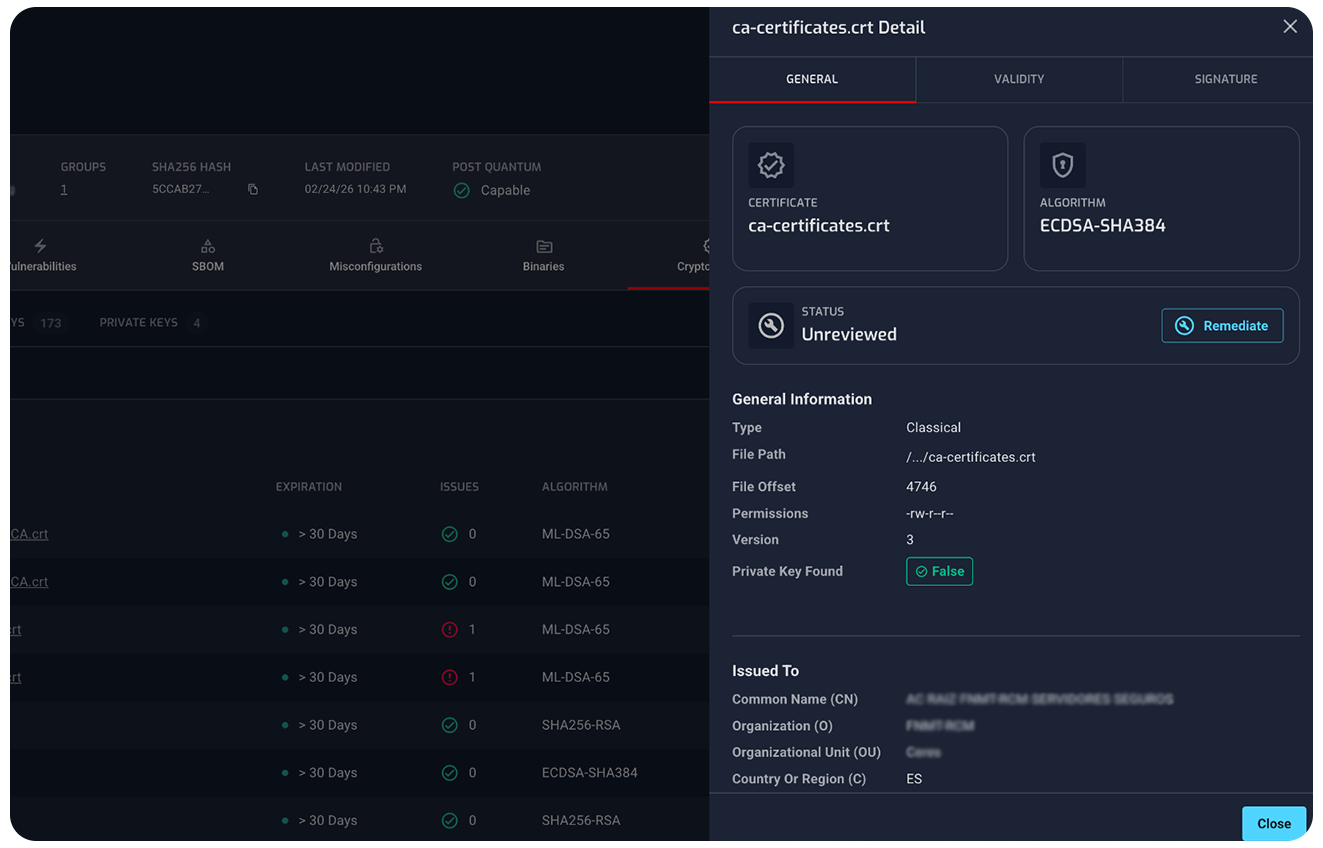
Analysis of all artifacts in the binary software or firmware is the only way to surface crypto as it actually exists in the shipped, deployed artifact.
Binary analysis is central to readiness for PQC compliance.
Learn how Turbine analyzes firmware, binaries, containers, and embedded software to uncover vulnerable algorithms.

What Binary Analysis Reveals

Cryptography Across Real-World Software Artifacts

Complete Cryptographic Material Extraction

SBOM Correlation

Cryptographic Analysis in Turbine Today
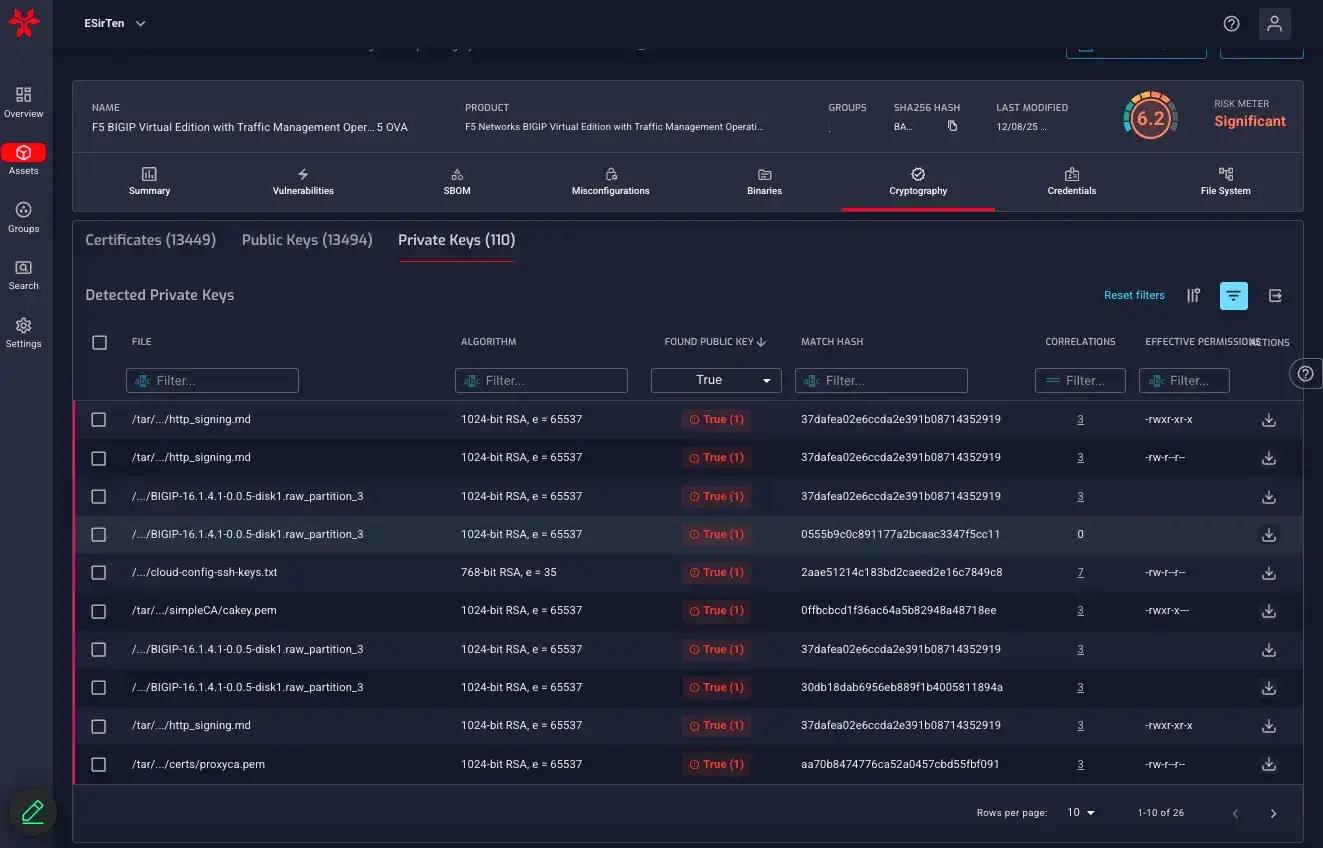
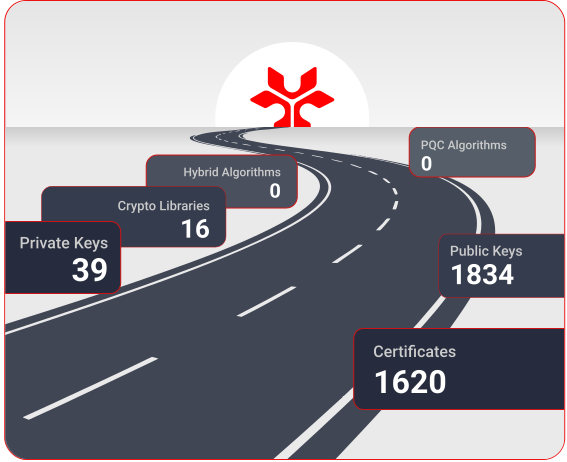
In analyzing binary images, Turbine reveals cryptographic artifacts such as detected certificates and public/private key pairs. The results show the scale and depth of algorithms that will be increasingly vulnerable as quantum computing becomes mainstream.

What This Means for PQC Compliance Readiness
The practical challenge of PQC Compliance readiness is discovering all the classical cryptography that must be replaced or modernized.
Organizations must:
- Locate and classify vulnerable algorithms
- Understand where cryptography is used in practice
- Prioritize long-lived assets
- Validate vendor claims
- Correlate SBOMs with binary reality
- Prepare a readiness strategy for PQC
Further Reading & Guidance
For organizations considering post-quantum readiness — across government, industry, and device ecosystems — the following resources outline the evolving expectations and timelines for PQC adoption:
- Executive Order 14412: Securing the Nation Against Advanced Cryptographic Attacks (White House, June 22, 2026) · Federal Register: 91 FR 38483
- Quantum Readiness: Migration to Post-Quantum Cryptography Factsheet (CISA + NIST + NSA)
- OMB Memo M-23-02 – Migrating to Post-Quantum Cryptography (OMB)
- National Security Memorandum-10 – Promoting U.S. Leadership in Quantum Computing While Mitigating Risks to Vulnerable Cryptographic Systems (White House)
- You Can't Migrate Cryptography You Can't Find (NetRise)
- NetRise PQC Report

Post-quantum readiness begins with understanding your cryptographic footprint. Visibility into the binaries you ship and deploy gives you the clarity to plan, prioritize, and execute a successful PQC transition.
Ready to Find the Cryptography You Have to Migrate?
The deadlines are set. The inventory has to come from the software itself. See how Turbine identifies quantum-vulnerable cryptography across firmware, software, and embedded systems.