






The Pentagon's New Software Security Directive Calls for Deeper Supply Chain Validation
For many organizations, commercial software has become a major contributor to security risk. Adversaries target vulnerable components inside third-party products and exploit weaknesses introduced during development and software builds. Yet your third-party risk management program may still emphasize questionnaires and vendor self-attestations over software inspection, creating blind spots that undermine vulnerability management, incident response, and a clear understanding of risk. You inherit these gaps whenever your suppliers fail to provide full visibility into the code you depend on.
As adoption of commercial software grows, these blind spots become practical obstacles for you and your teams. A lack of supplier transparency forces your teams to work with partial or outdated information often prolonging incident response. When a critical vulnerability or incident emerges, your team must first track down supplier advisories, request clarifying evidence, and manually reconcile inconsistent SBOMs before they can even confirm whether you are exposed. This slows containment, delays communication to leadership, and increases the risk that attackers exploit the gap between initial detection and verified exposure.
Your leadership team now views software exposure as a meaningful business risk, and supplier-related breaches continue to rise. Addressing this requires a structured approach that brings clarity to how you evaluate and manage commercial software.
The following guidance illustrates how you, as a CISO, can update your program to strengthen commercial software supply chain security (SSCS).
Recognize That Commercial Software Introduces Hidden ExposureModern software blends proprietary code, open-source libraries, third-party components, and artifacts introduced in the binary package. Your suppliers’ documentation rarely reflects this complexity. Vulnerable components may be buried deep in dependencies, rendering them invisible, misconfigurations may persist across versions, and build pipelines may introduce additional files that no questionnaire will reveal.
This complexity, and especially that 80% of the code in your product often comes from third parties/open source, means you need to treat commercial software as a dynamic supply chain rather than as a static product. Traditional third-party cyber-risk assessments must expand to include the software and components themselves, not just a supplier’s product security practices.
Most TPRM programs were not built to assess software directly. They fail to directly evaluate inherited dependencies and non-CVE risk. They don’t take into account how a software build can change what was declared in the source code. This leaves you and your organizations blind to many risks hidden in the commercial products you procure and deploy.
Your TPRM program must extend beyond the traditional bellwethers used to measure the maturity of governance programs, such as policies, certifications, and questionnaires, to evaluate:
As a CISO, you should define risk-based SSCS requirements tied to your third-party criticality tiers. This allows you to apply consistent SSCS standards across supplier categories and focus assurance efforts on higher-risk software. As part of this assessment, you must review secure development evidence to determine whether your suppliers meet the SSCS standards defined for their risk tier.
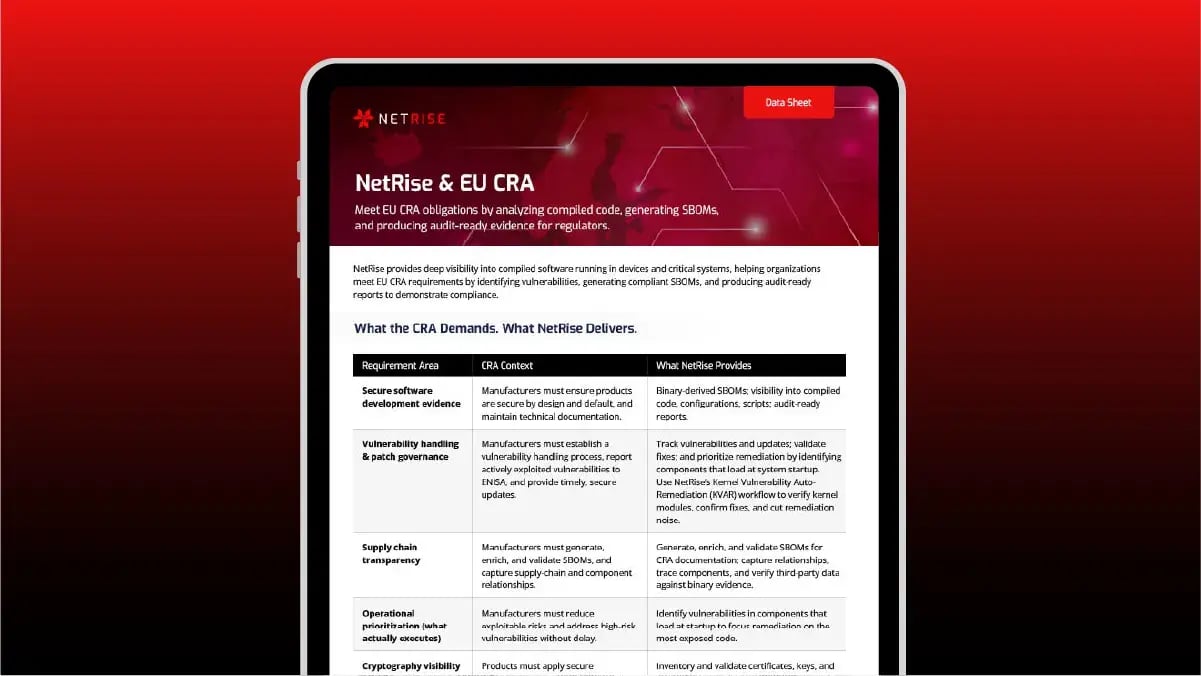
Supplier-provided SBOMs often miss more than just hidden dependencies. They usually omit non-CVE risks like hard-coded secrets, exposed keys and certificates, insecure configuration, weak or outdated cryptography, and end-of-life components, which together represent the largest blind spot in most vendor SBOMs. Independent verification through binary composition analysis validates and enriches these SBOMs, uncovering hidden components and exposures that vendor artifacts overlook. NetRise supports this work by producing binary-derived SBOMs that reflect what actually executes within your software.
When new vulnerabilities emerge, your teams must determine whether the compromised component exists in your environment, whether it executes, and whether it introduces real exposure. Without an accurate, comprehensive software inventory, these questions consume time and erode confidence.
Your software supply chain security program must integrate commercial supply chain intelligence — including verified SBOM inventories and supplier vulnerability dispositions — directly into vulnerability and incident workflows. This includes correlating component inventories with active threat intelligence and vulnerability databases to identify component-level risk as it emerges.
Verified SBOMs accelerate component discovery and version verification. Execution-aware reachability provided by NetRise helps you identify whether vulnerable functions initialize at startup and are reachable over the network, allowing teams to focus on real exposure rather than theoretical weaknesses.
Procurement now plays a central role in managing software supply chain risk. You must collaborate with procurement teams to:
These expectations scale with product risk, requiring deeper analysis and validation for high-impact software. NetRise supports pre-procurement evaluation by helping your teams validate supplier claims and identify discrepancies early.
Software supply chain oversight in your organization cannot stop at onboarding. Your suppliers update libraries, release new versions, and patch vulnerable versions. Your program must establish continuous monitoring practices that include:
For critical and high-risk software, you must perform binary composition analysis to validate SBOM completeness and uncover supply chain risks such as weak cryptography, hard-coded secrets, and unexpected embedded components. NetRise supports this work by producing binary-derived SBOMs and evidence that your security teams can use to verify supplier claims, evaluate the security impact of updates, and document your organization’s expected security posture.
Supply chain intelligence delivers value only when you embed it into daily workflows. You must partner with security and IT stakeholders to deploy preventive controls and define automated detection and response workflows for critical zero-day vulnerabilities.
You should use software intelligence to guide:
This allows your teams to detect unexpected behavior in new deployments and align remediation decisions with actual exposure. NetRise provides the software intelligence and verified data you need to support these operational workflows.
You must demonstrate program maturity through metrics that reflect transparency and supplier performance, including:
NetRise supports these KPIs by generating accurate and comprehensive SBOMs, maintaining a software asset inventory of what is actually installed and running, and enabling you to quickly locate risky components across your environment.
Software supply chains will always introduce complexity, but uncertainty does not need to follow. If you adopt these practices, you gain a clearer understanding of the software your organization depends on and improve your ability to respond to emerging threats. Verification, transparency, and operational integration form the foundation of a modern software supply chain security strategy.
NetRise supports this shift by delivering the visibility and intelligence you need to make informed decisions, reduce exposure, and build resilient software security programs based on what actually executes.