





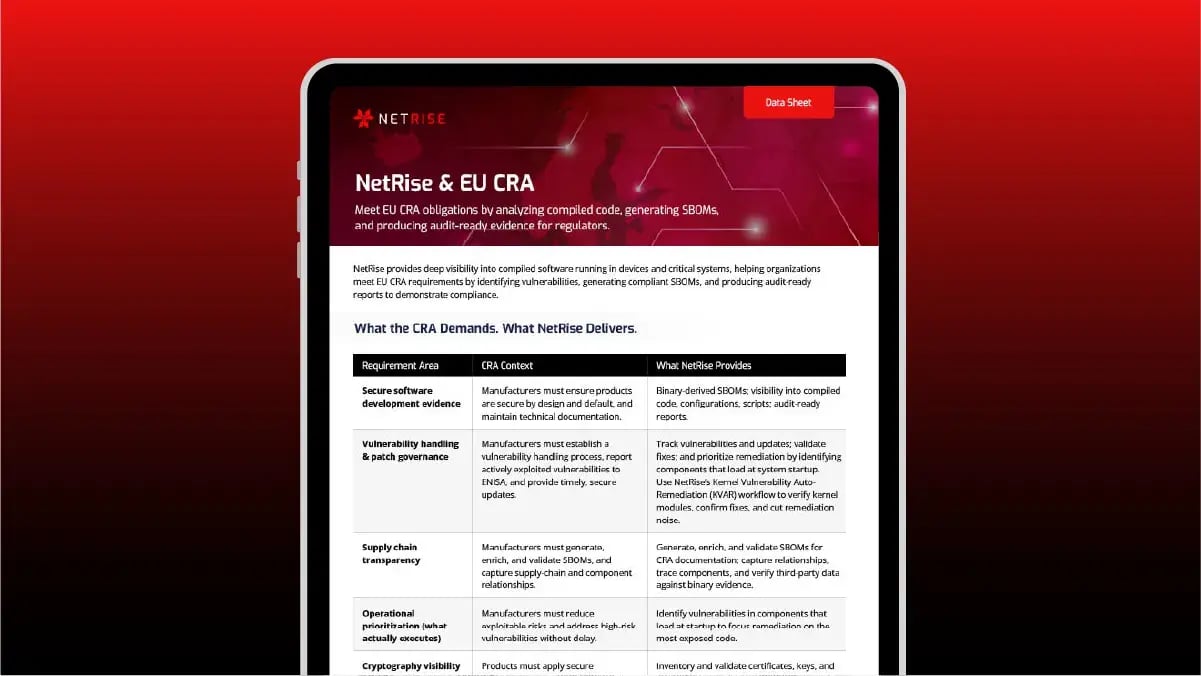


NetRise Trace® – Expose Behavioral Risk and Hidden Vulnerabilities in Compiled Code
Traditional scanning stops at known threats. NetRise Trace goes further, exposing the intent and behavior of compiled code to reveal risky functionality and inherited vulnerabilities—even without source code.
Hidden Risk in Your Attack Surface
Most vulnerability scanners only check known issues and manifests. NetRise Trace reveals risk that traditional tools miss, such as unsafe commands, risky configurations, and inherited vulnerabilities buried in binaries.
Key Takeaways:
-
Use intent-driven search to detect suspicious behavior with natural language or code snippets.
-
Map the blast radius of threats to see how widely they propagate across builds.
-
Find vulnerabilities in interpreters, scripts, and configs overlooked by conventional scanning.
-
Identify which code is actually reachable at runtime, not just present in theory.
-
Query artifacts without rescanning, saving time and resources.
Why This Data Sheet Matters
Attackers exploit hidden functionality and inherited flaws that aren’t visible in manifests or static scans. This paper explains how NetRise Trace enables teams to:
-
Detect overlooked risk in compiled code and interpreters.
-
Trace behavior across files, languages, and runtime paths.
-
Validate findings with deterministic checks tied to CWE and OWASP.
-
Strengthen compliance and audit readiness with artifact-level evidence.
What You’ll Learn in This Data Sheet
-
How scanners miss real risk from static linking, vendored libraries, and build pipelines.
-
How to operationalize visibility with execution-aware reachability and behavioral analysis.
-
How to prioritize threats by mapping exploitable functions and runtime paths.
-
Why intent-based search delivers faster, more accurate detection of anomalies and vulnerabilities.
Who Benefits from NetRise Trace
-
Security Operations Teams – triage software risk with runtime-aware context.
-
Product Security Engineers – detect risky command logic early in development.
-
Compliance & Risk Leaders – validate SBOMs and meet audit requirements.
-
Red Teams & Researchers – uncover overlooked flaws and inherited vulnerabilities.
-
Third-Party Risk Managers – independently assess supplier software.
-
Incident Response Teams – accelerate investigations without relying on source code.
Ready to Trace What’s Inside Your Code?
Want to know what you code is doing? Let's trace it.
Get the NetRise Trace Data Sheet to explore how intent-driven search, runtime reachability, and behavioral analysis expose risk traditional scanners miss.