






PROVENANCE INTELLIGENCE
Blind Trust in Open-Source Software? Not Anymore.
You can’t control who contributes to open-source libraries. But now you can learn which libraries to trust, how far risky dependencies reach, and enforce policies to reduce your risk.
The Challenge
Open-Source Risk Enters Two Ways
Open-source packages, dependencies, and the installs your AI assistant automatically performs all end up compiled into what you release.
Every purchased device, appliance, and commercial application ships with third-party open-source your vendor ingested, not wrote.
- Block malicious and out-of-policy packages before they reach a build.
- Replace manual package review with one data-driven trust standard.
- Enforce that standard at the editor, CLI, and CI/CD — even packages your AI assistant suggests.
NetRise Provides Dependency Trust You Can Enforce
- Scope how far a risky dependency reaches across your products and vendors in minutes.
- Judge the open-source inside vendor software on origin, health, and maintainer risk.
- Know which deployed products inherit a newly disclosed dependency risk.
- Should this package enter our build?
- Who's behind it, and can we trust them?
- Does it meet our software provenance policy?
- If it turns risky tomorrow, how far does it reach?
Common Questions
- What open-source is inside this vendor's software?
- Who maintains it, and where are they located?
- Is the project behind it maintained regularly, or decaying?
- Which of our deployed products inherit its risk?
- Open-source governance
- Package policy enforcement
- Malicious package blocking
- AI-assisted development security
- CI/CD dependency control
Common Workflows
- Vendor dependency review
- Third-party software risk assessment
- Open-source provenance verification
- Maintainer and origin due diligence
- Incident scoping and blast radius
Open-source packages, dependencies, and the installs your AI assistant automatically performs all end up compiled into what you release.
NetRise Provides Dependency Trust You Can Enforce
- Block malicious and out-of-policy packages before they reach a build.
- Replace manual package review with one data-driven trust standard.
- Enforce that standard at the editor, CLI, and CI/CD — even packages your AI assistant suggests.
Common Questions
- Should this package enter our build?
- Who's behind it, and can we trust them?
- Does it meet our software provenance policy?
- If it turns risky tomorrow, how far does it reach?
Common Workflows
- Open-source governance
- Package policy enforcement
- Malicious package blocking
- AI-assisted development security
- CI/CD dependency control
Every purchased device, appliance, and commercial application ships with third-party open-source your vendor ingested, not wrote.
NetRise Provides Dependency Trust You Can Enforce
- Scope how far a risky dependency reaches across your products and vendors in minutes.
- Judge the open-source inside vendor software on origin, health, and maintainer risk.
- Know which deployed products inherit a newly disclosed dependency risk.
Common Questions
- What open-source is inside this vendor's software?
- Who maintains it, and where are they located?
- Is the project behind it maintained regularly, or decaying?
- Which of our deployed products inherit its risk?
Common Workflows
- Vendor dependency review
- Third-party software risk assessment
- Open-source provenance verification
- Maintainer and origin due diligence
- Incident scoping and blast radius
Different Workflows. One Requirement.
Both lanes decide on the same open-source with the same nothing to go on. What they need is the record behind the component: origin, maintainers, and reach.
Get a DemoThe Solution
One Trust Standard, Wherever Open-Source Enters
Whether you pull open-source into what you build or inherit it inside the software you buy, the question is the same: can this dependency be trusted? NetRise Provenance® answers it with one standard — deciding what to allow into a build, blocking what shouldn't be there, and mapping how far a risk reaches when a dependency turns risky.
Provenance for Software Builders
When a package you pulled turns malicious, one trust standard should catch it at every point a dependency enters — before it's ever downloaded:
In the editor — the VS Code extension flags risky packages before commit.
At the command line — the Package Firewall CLI enforces policy in local and CI workflows.
In AI assistants — plugins (starting with Claude Code) hold AI-suggested packages to the same standard.
Provenance for Software Buyers
Vendor software runs on open-source no questionnaire can see. When a component is compromised, Provenance maps every dependency that inherits it — and which of your products contain them.
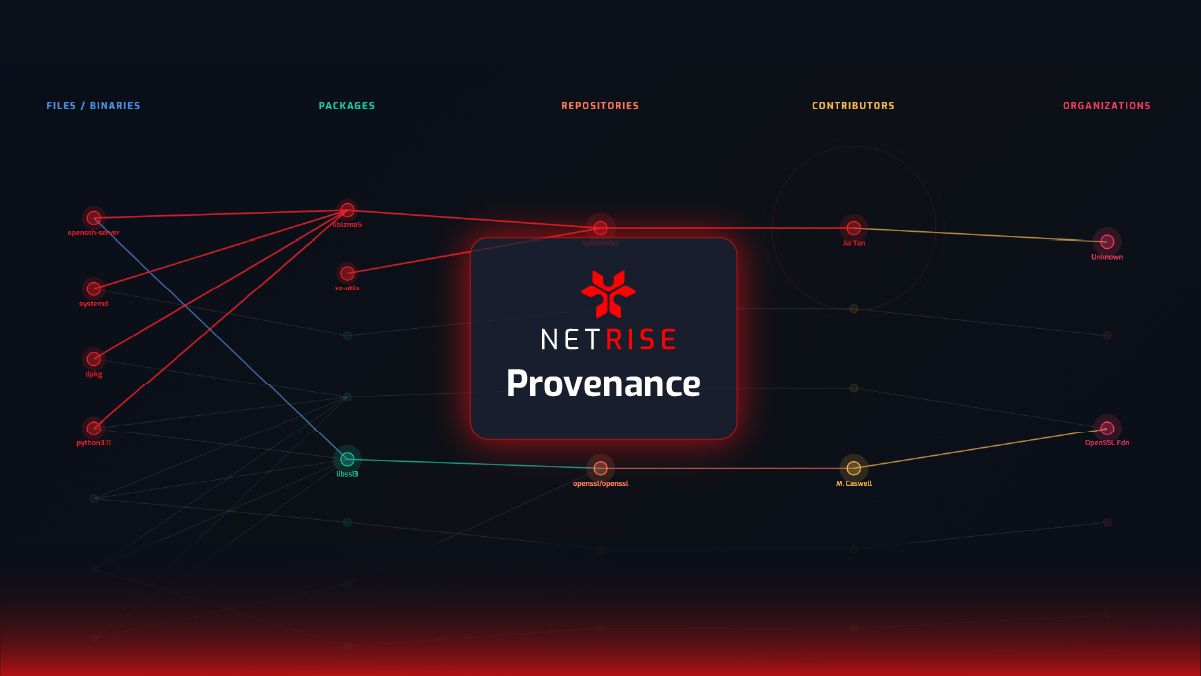
Blast Radius — how far a compromised component reaches: the libraries and dependencies that inherit it, and which of your products and assets contain those components.
Repository Health & Security Signals — whether the project behind a component is maintained or decaying.
Contributor & Organization Attribution — who maintains it, where they're based, and whether they carry known risk.
Build or Buy. One Trust Standard.
In the build, Provenance allows trusted open-source and blocks the rest — at the editor, CLI, and CI/CD.
In what you buy, Provenance shows you where the open-source inside vendor software actually comes from, and how far a compromised component reaches into what you run.
Answer, in minutes:
- Should this dependency be allowed in?
- How far does its risk reach?
- Who stands behind it?
- What should we block or replace first?
Ready to Decide What Open-Source to Trust?
Whether you build software or buy it, know which open-source you can trust — and how far a risk reaches when one turns.
Frequently Asked Questions
What is software provenance?
Software provenance is the record of where an open-source component comes from — its origin repository, the maintainers and organizations behind it, and the health of the project. NetRise Provenance uses those signals to decide whether a dependency should be trusted, blocked, or replaced.
How does NetRise Provenance stop malicious open-source packages?
Provenance's Malicious Package Detection & Blocking continuously evaluates open-source packages as they're published to public registries and judges malicious intent. Its enforcement surfaces — the Package Firewall CLI, the VS Code extension, and AI coding assistant plugins — reject malicious and policy-violating packages before they're downloaded into a developer's machine or a build.
What is blast radius in software supply chain security?
Blast radius is how far a risky package, repository, or maintainer propagates across your products and vendors once it's implicated. NetRise Provenance maps that propagation so teams can scope an incident in minutes instead of tracing dependency chains by hand.
Can Provenance check packages suggested by AI coding assistants?
Yes. Provenance plugins for AI coding assistants, starting with Claude Code, check the packages an assistant suggests against the same policy and advisories a human would hit — so AI-introduced dependencies meet the same trust standard as everything else. Initial support is for the Python (PyPI) ecosystem.