






The New AI and Cybersecurity Executive Order Has a Visibility Problem
Federal civilian agencies are now on a three-day clock for the most dangerous vulnerabilities, and meeting it depends on evidence the risk model can't generate on its own.
Binding Operational Directive 26-04 (BOD 26-04), issued June 10, sets defined deadlines for how fast agencies have to remediate based on risk. The most dangerous vulnerabilities — publicly exposed, on CISA's KEV list, exploitable through an automated attack chain, and capable of giving an attacker total or partial control of the system — now carry a three-day deadline, with forensic triage on top. Mid-tier findings get 14- or 60-day timelines and the lowest-risk can wait for the next scheduled system upgrade. But for the vulnerabilities with the highest risk, this is a sharply higher bar than the timelines it replaces.
The tight deadline is narrowly targeted by design. In an initial analysis at one large civilian agency, only about one percent of vulnerability instances landed in the three-day tier, while more than sixty percent could wait until the next scheduled system upgrade — but that one percent now has to move faster than anything the agency was held to before.
The reason that one percent can't wait is AI. Attackers are now using AI to compress the window between a patch's release and its exploitation, turning vulnerabilities into working exploits in days. A remediation timeline that made sense when exploitation took weeks is dangerously slow when it takes days — which is why CISA built the three-day tier, and why it warned that AI is shortening the window further. Acting CISA Director Nick Andersen framed the change as empowering agencies to concentrate on the highest-risk areas, and CISA encouraged organizations outside the federal government to adopt the same approach.
The logic is sound, but everything rests on the word 'risk.' Tiering only helps if an agency can tell which tier each vulnerability belongs in, and that takes evidence: which vulnerabilities a given asset actually carries, and which risk variables apply to each one.
The highest-risk vulnerabilities tend to live where conventional tools don't look. Manifest-based scanners read what a vendor declared. Agent-based scanners cover what an agency can install software on. Neither reaches inside firmware, embedded systems, or the third-party and statically linked components compiled into commercial software, which is exactly where the vulnerabilities with real risk most often sit. An agency can run a flawless risk-based process and still misfile its most dangerous vulnerabilities, because it never found them.
BOD 26-04 places every vulnerability into a remediation tier using four inputs: whether the asset is publicly exposed, whether the vulnerability is on the KEV catalog, whether exploitation can be automated, and whether a successful exploit yields partial or total control. Three of those four describe the software itself; only exposure describes the network around it.
That distribution is where the directive's data demand becomes a binary-analysis problem. Identifying KEV-listed CVEs inside firmware and third-party code, surfacing the exploit-automation signals the 'automatable' call rests on — exploit maturity, exploit-code availability, and EPSS — and determining whether a vulnerable component is even reachable in the code that runs are all determinations you make by analyzing the artifact, not by reading a manifest. Produce them from the binary and three of the four tiering inputs are answered with evidence. Exposure stays the agency's call, drawn from its own attack-surface data.
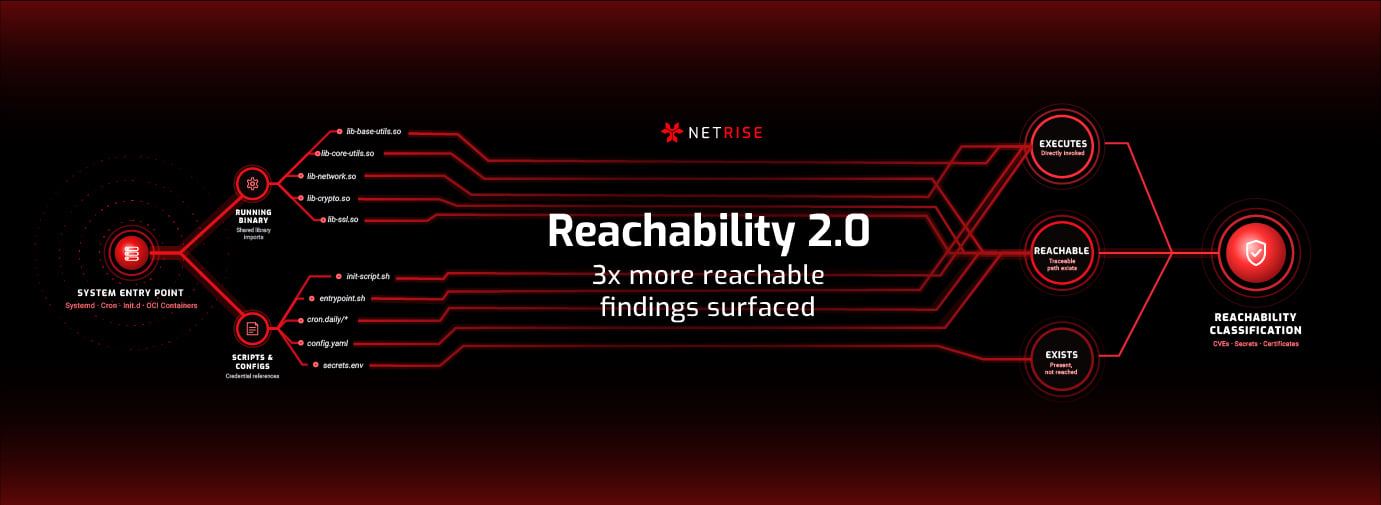
Reachability is the input that does the most to keep the fast lanes honest. A vulnerability that exists in an image but is never loaded by running code is not the same risk as one an attacker can actually reach, and the three-day clock should be spent on the latter. Execution-aware analysis draws that line. In a six-month sample, applicability analysis narrowed 3.8 million raw CVE matches to roughly 61,000 genuinely exploitable findings, close to a 98 percent reduction in noise. That is the difference between a triage queue an agency can clear in three days and one it cannot.
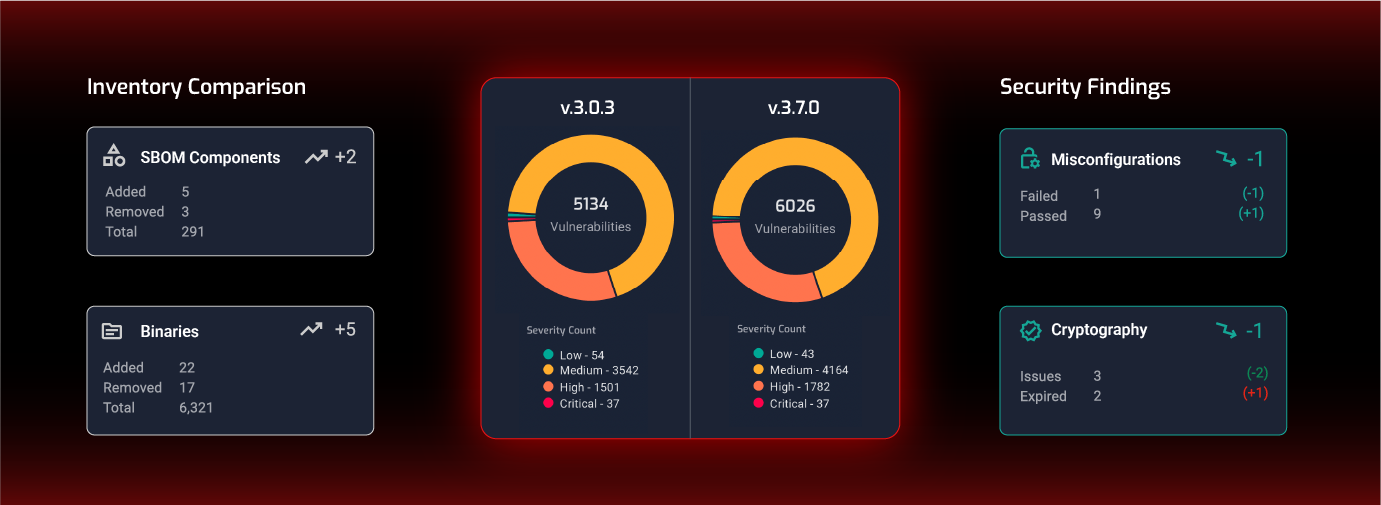
If the component inventory is maintained continuously, the affected assets are known the moment a CVE lands on the KEV catalog. There is no discovery scramble against the clock, because the footprint map already exists. With the gap between disclosure and exploitation now measured in days, a compression CISA itself flagged, that head start often decides whether the three-day lane is met or missed.
It also changes the unit of remediation. A reachable vulnerability in a shared library is inherited by every binary that loads it, across every system that ships that binary. Resolving it to its full footprint across agencies, systems, and artifacts, rather than counting it asset by asset, aims remediation where the exposure actually reaches, and turns a directive written for single agencies into something that scales across an enterprise.
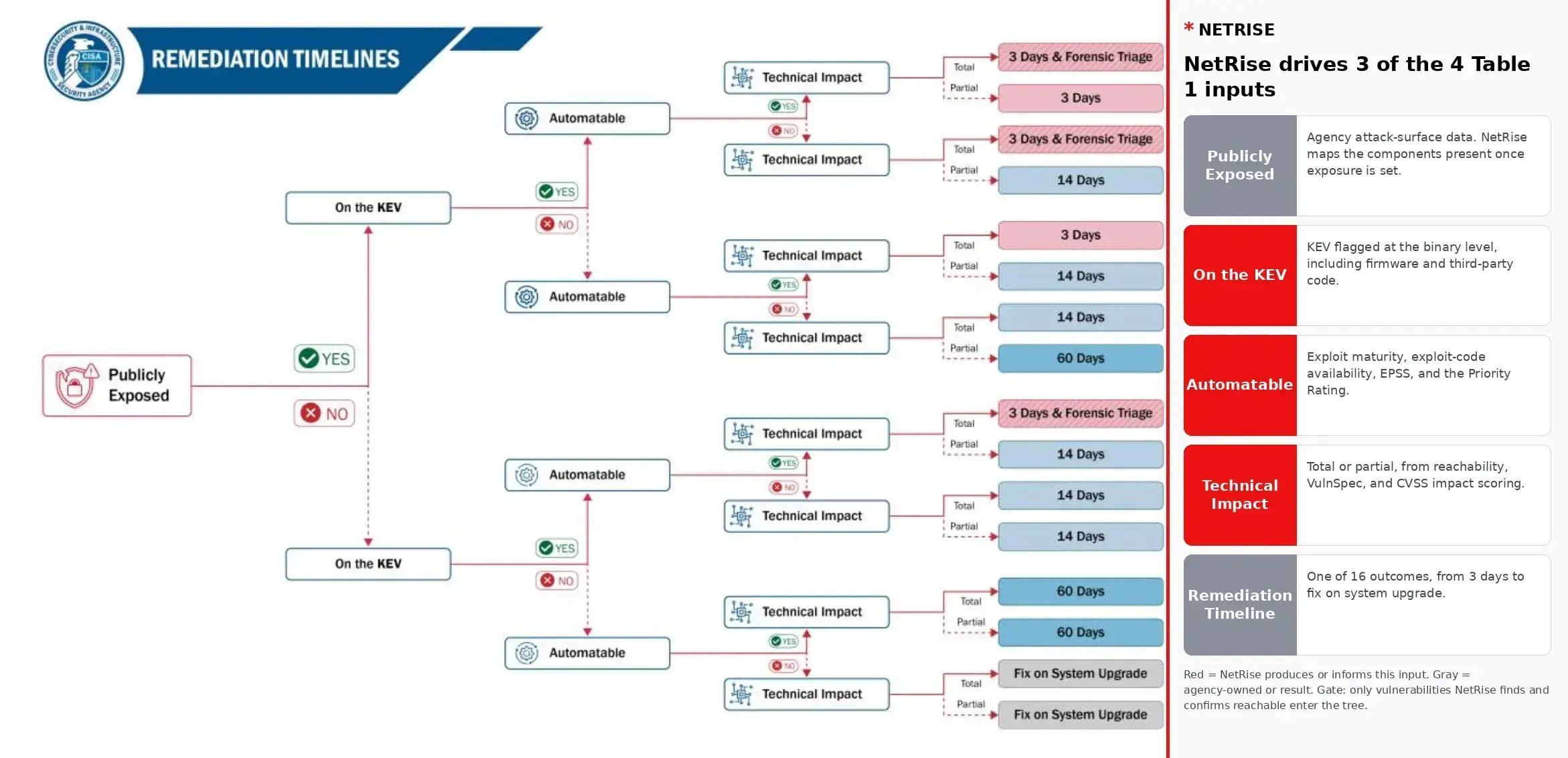
This is the evidence NetRise Turbine® is built to produce. It analyzes compiled software and firmware at the binary level, across embedded Linux, real-time operating systems, container images, and more than 200 software artifact types. It identifies the components inside a delivered artifact, including third-party and embedded code, with no source code, endpoint agents, network access to live systems, or vendor cooperation. It flags KEV status at the component level, supplies the exploit-automation signals the "automatable" call rests on, and uses execution-aware reachability to indicate whether a vulnerable component is actually reached. That output feeds the CDM Agency and Federal Dashboard in CycloneDX and SPDX, and it produces the per-asset, machine-readable component data agencies will need to meet CISA's standardized asset-tagging requirements, without relying on vendor-supplied SBOMs.
NetRise Provenance® addresses the part of the problem that starts before a vulnerability is ever filed. Its policy engine blocks malicious or untrusted packages at build time and at procurement, using provenance, repository health, geography, and organizational risk signals, which is how an agency keeps the next high-risk component from entering at all. And by mapping dependency and reverse-dependency relationships across millions of packages and repositories, it shows how far a given exposure propagates across libraries, products, and vendors, the supply-chain reach behind a single implicated component.
CISA was explicit that the directive is a floor, not a ceiling, and encouraged organizations outside government to adopt the same risk-based model. The reasoning travels. Any enterprise drowning in CVEs faces the problem the directive is trying to solve: too many vulnerabilities and too little signal about which ones present the most risk. The fix starts in the same place, with evidence drawn from the artifact rather than the declaration.
BOD 26-04 asks agencies to spend their limited remediation time where the risk is real, while deferring the rest. But the model only works if agencies can produce the analysis and evidence to support it. Those agencies can clear the three-day remediation window. The others are guessing against a three-day clock, in the components it can least afford to miss.
NetRise produces the component-level, reachability-aware evidence that risk-based prioritization runs on, at the binary level, for any vendor, without source code or cooperation. See how NetRise works → https://www.netrise.io/demo-request