



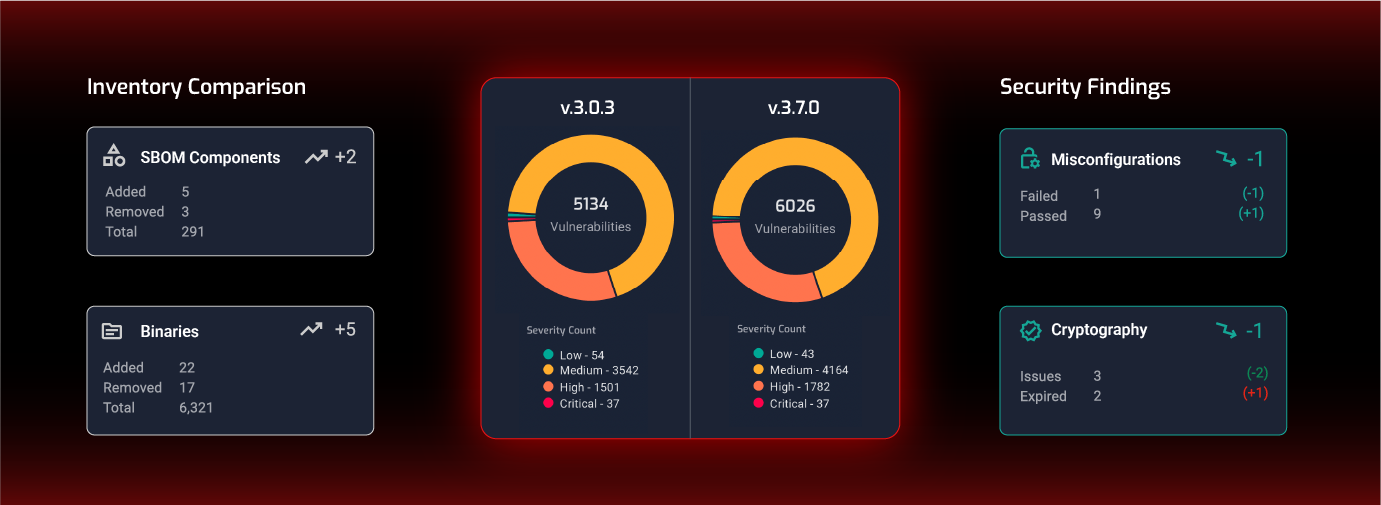
See What Changed. Prove What Improved. Fix Real Risk.
Security teams rarely lack data.
What they lack is time to find the right answer.
Modern firmware and software supply chain analysis produces enormous volumes of information — SBOM inventories, vulnerability intelligence, exploit signals, cryptographic artifacts, binary protections, credential exposure, and more. But turning that intelligence into decisions often requires navigating multiple dashboards, running new searches, and manually correlating findings.
That delay shows up exactly when teams need to determine what is affected, how exploitable it is, and what to do next.
RiseAI Chatbot, now available inside the NetRise platform, removes that friction by introducing a conversational way to investigate software risk.
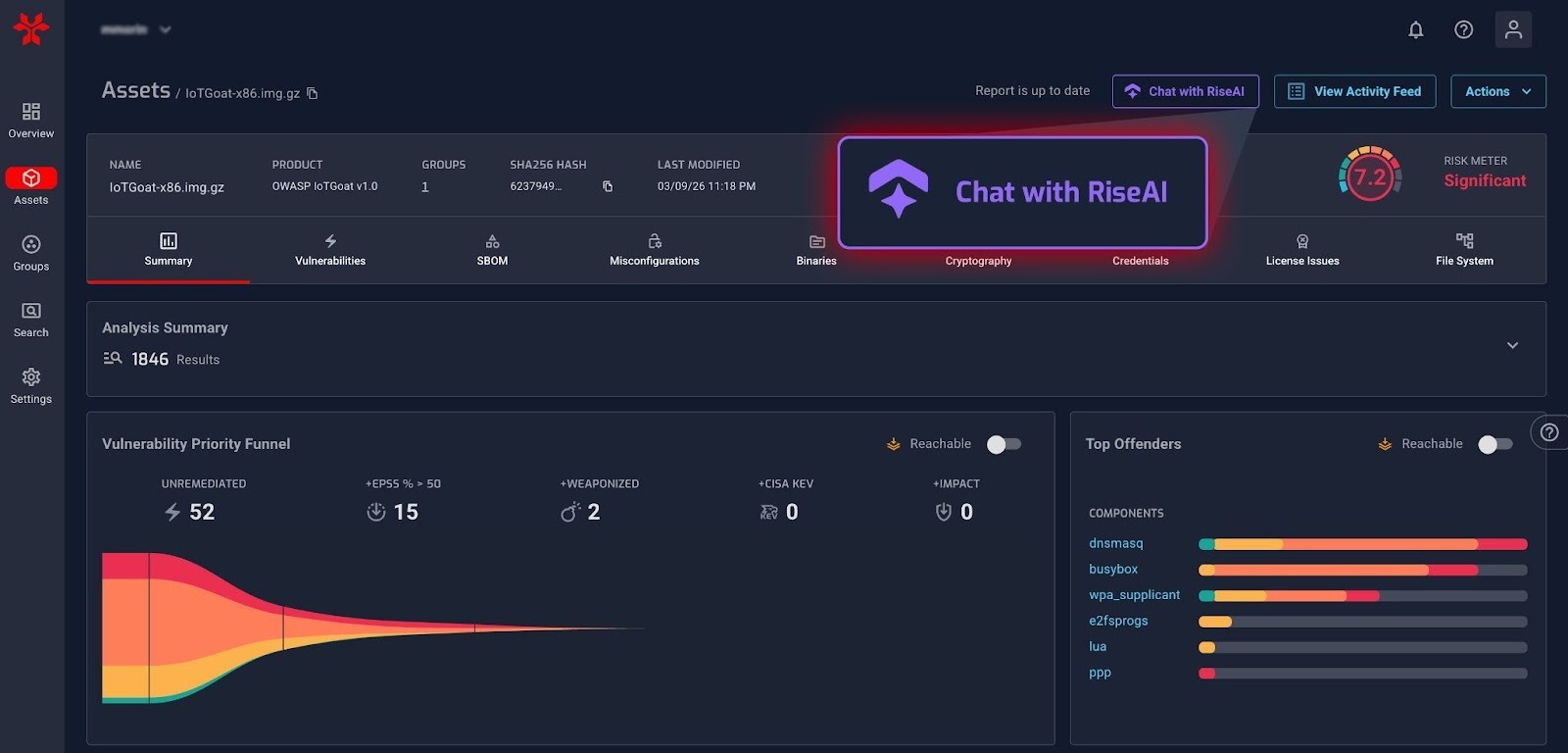
Embedded directly within the Asset View, RiseAI Chatbot allows security teams to query asset intelligence using natural language. Instead of navigating across multiple views to locate vulnerability data, component details, or remediation status, teams can ask a question and get an immediate answer.
And when the answer requires action, authorized users can move directly into remediation with explicit confirmation.
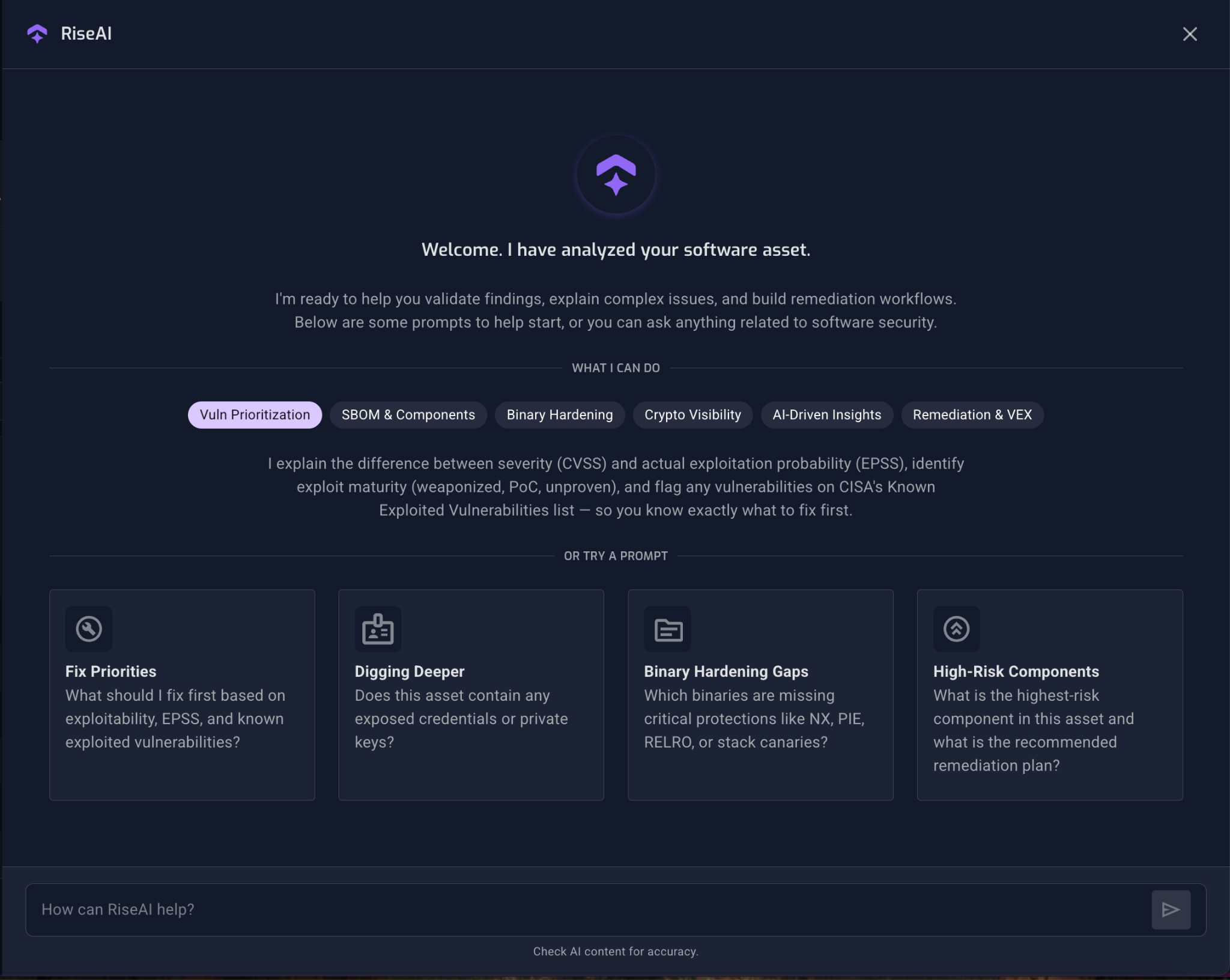
Security investigations usually begin with a simple question.
With RiseAI Chatbot, teams can ask questions in plain English and receive contextual answers for the asset they’re investigating, including SBOM inventories, vulnerability intelligence, exploit signals, and security posture analysis.
Example queries include:
Questions and requests that normally require navigating several views can now be handled within a single conversation.
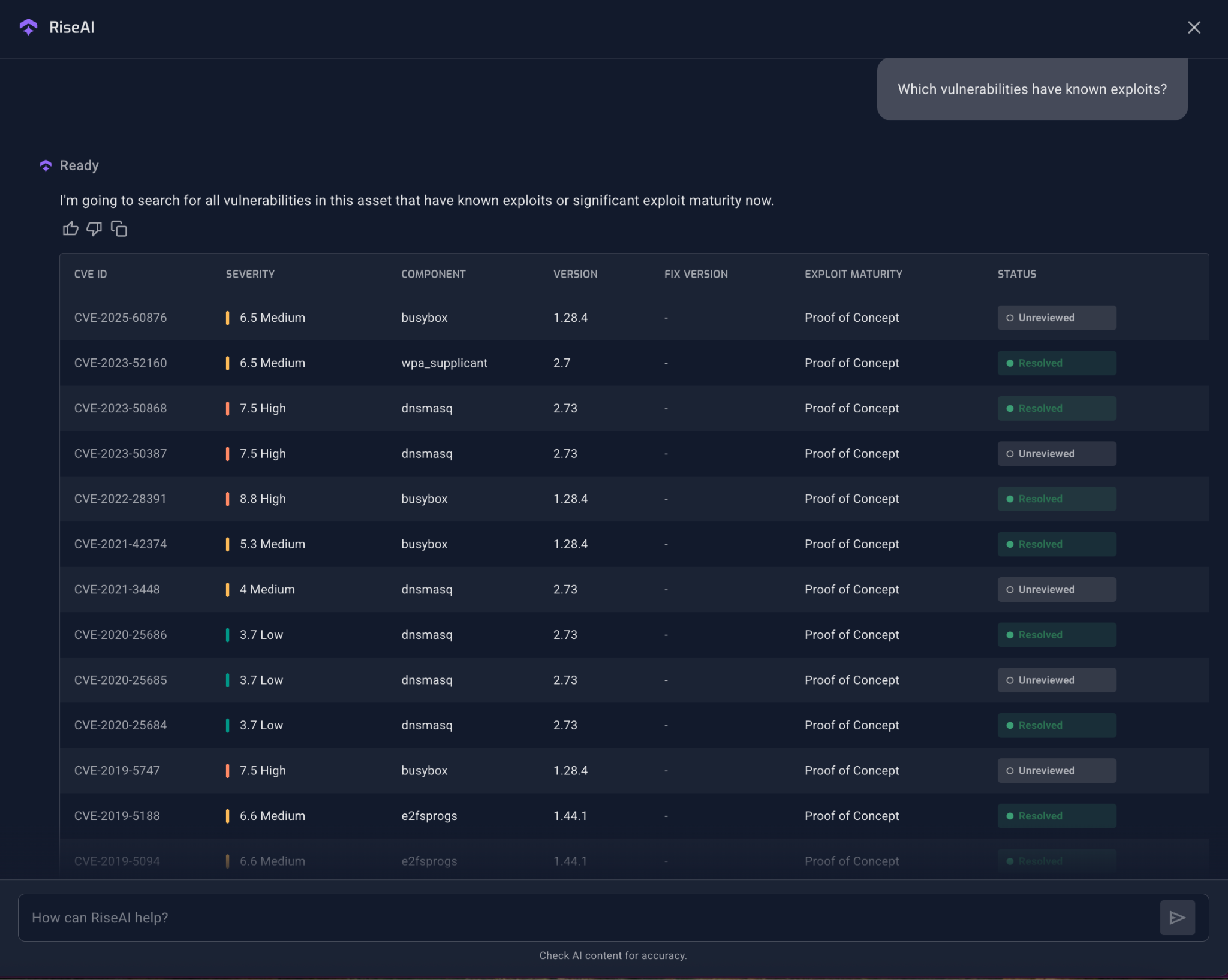
Security risk rarely appears in only one place within a software asset.
When a vulnerability is discovered, security teams need to understand what components are affected, how exploitable the issue may be, and what to do next.
RiseAI Chatbot makes that investigation immediate.
Teams can ask:
Instead of manually navigating between views or running additional searches, teams can quickly investigate the issue in context and move faster toward remediation.
Security platforms often stop at showing information.
RiseAI Chatbot helps teams act on it.
From the same conversation used to investigate an issue, operators can initiate remediation workflows without leaving Asset View. This shortens the path from identifying a vulnerability to addressing it.
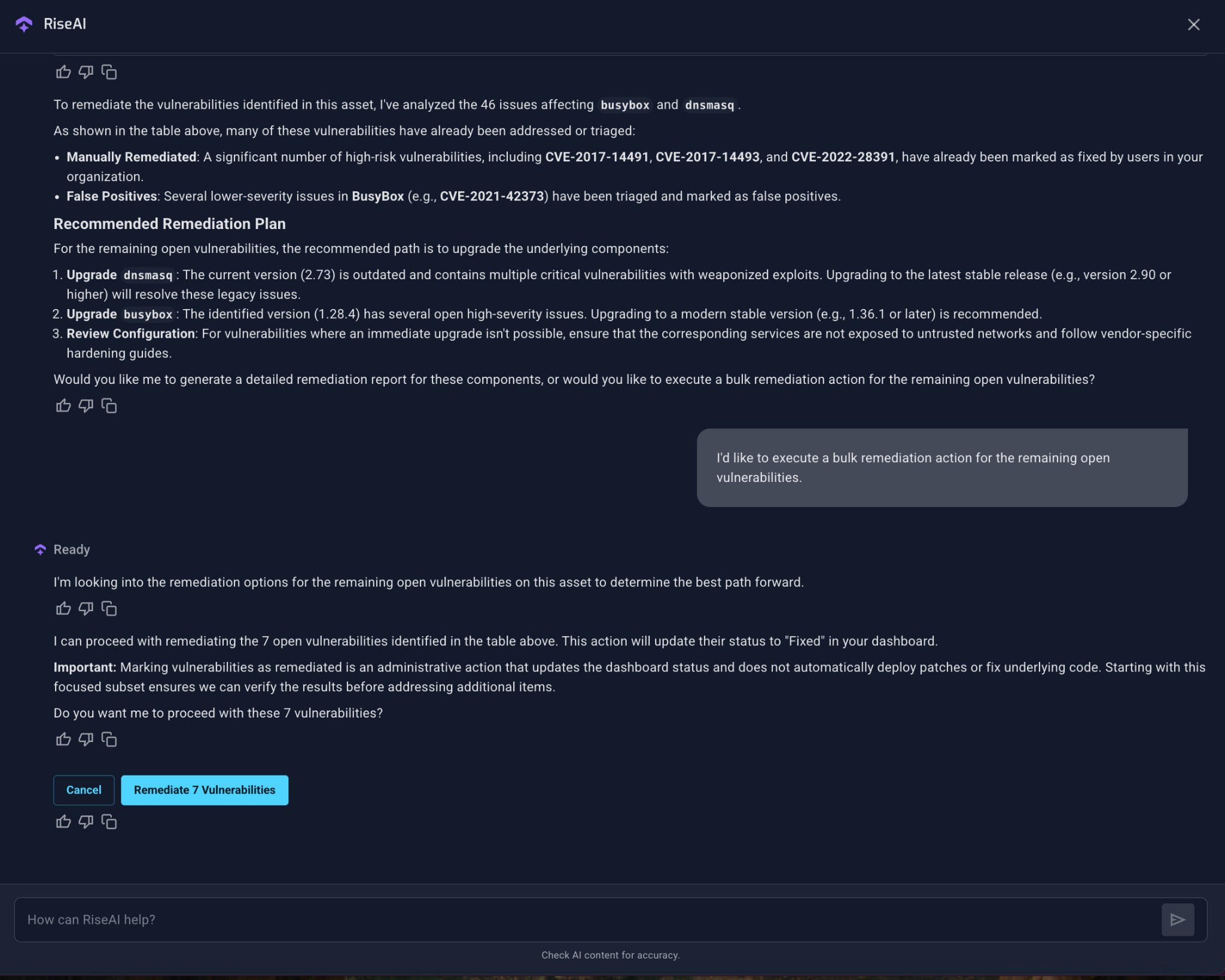
All remediation actions include built-in safeguards:
RiseAI Chatbot provides access to the same analysis capabilities that power the NetRise platform, including detailed insight into software composition, vulnerability exposure, and security posture.
Security teams can explore asset software composition, including CPE and PURL identifiers, license types, and package classifications. RiseAI also surfaces how each component was identified, including techniques such as symbol indexing, binary fingerprinting, signature detection, and package manifest analysis.
The chatbot retrieves vulnerabilities associated with asset components and provides context to help prioritize remediation. This includes CVSS severity scores, exploit intelligence such as Known Exploited Vulnerabilities (KEV) status and proof-of-concept availability, EPSS probability scores, and VEX status information.
RiseAI Chatbot can summarize security posture indicators across multiple domains, including binary hardening protections, certificate validity, configuration issues, credential exposure, and post-quantum cryptography readiness.
RiseAI Chatbot builds on the earlier release of NetRise AI Insights, which generates AI-authored reports for assets with negligible risk scores.
Insights provides structured summaries of low-risk assets, including entropy analysis, architecture detection, and component identification.
RiseAI Chatbot introduces a different interaction model: conversational investigation and action.
Together, they form the RiseAI product suite.
| Product | Description | Status |
| RiseAI Insights | AI-generated PDF reports summarizing negligible-risk assets, including entropy analysis and architecture detection. | Live |
| RiseAI Chatbot | Conversational assistant for exploring asset intelligence, investigating vulnerabilities, and initiating remediation workflows. | Live |
Conversational AI inside a security platform must operate within strict security boundaries.
RiseAI Chatbot was designed with those protections built directly into the system.
Safeguards include:
Additionally, RiseAI features are disabled by default and must be explicitly enabled by an Owner or Admin.
Firmware and embedded software have historically been opaque.
NetRise changed that by making them analyzable.
RiseAI takes the next step by making that intelligence immediately accessible and actionable.
Instead of searching across dashboards to find answers, security teams can ask questions directly inside the platform.
And act on what they discover.