







EU CRA Compliance
Prepare for EU CRA obligations with evidence based on binary artifacts rather than source code: SBOMs, vulnerability handling documentation, and reporting that holds up in audits.
What is the EU Cyber Resilience Act (CRA)?
The EU Cyber Resilience Act (CRA) establishes cybersecurity requirements for products with digital elements, including hardware, software, and related remote data processing solutions sold in the European Union. The act aims to reduce software risk, improve transparency for buyers, and standardize how manufacturers manage, remediate, and report vulnerabilities across the product lifecycle.

What’s in the EU CRA Scope?
CRA covers products with digital elements, including:
- Software products
- Hardware products
- Remote data processing solutions related to those products
- Third-party software components included in the released product (including open source dependencies)

CRA compliance requires an evidence trail of what you shipped, what you knew, what you fixed, and how quickly you reported.

The common ways teams try to prove CRA readiness and where they get stuck
Teams typically rely on one of four approaches. Each can create blind spots when you need evidence that reflects what’s in the released product.
1
Source-only SBOMs
SBOMs built only from source and manifests reflect what developers intend. They can miss what ends up in the final release after builds and packaging.
2
Point-in-time scans and snapshots
Periodic scans capture a moment, not a release history. They don’t reliably show what changed between versions or the latest updates.
3
Questionnaire-based supplier attestations
Supplier questionnaires are often incomplete or inconsistent. They rarely map cleanly to the exact component versions and configurations present in your final release.
4
Patch status reporting without verification
“Patched” claims must be verified. You also must show that patches introduce no new vulnerabilities.
What the CRA Demands.
What NetRise Delivers.
CRA readiness depends on evidence you can defend—what’s in the released product, how vulnerabilities are handled, and what documentation supports reporting and assessment.
NetRise provides CRA-ready evidence such as:
- Release-build SBOMs that are accurate and comprehensive
- Documentation across configurations and scripts to support audits
- Vulnerability handling and patch verification across versions
- Validated supply chain transparency (components, versions, relationships)
- Runtime exposure prioritization (including startup-loaded components)
- Cryptography inventory (certificates, keys, and crypto artifacts)
- Assessment-ready reporting outputs to support CRA conformity and CE evidence
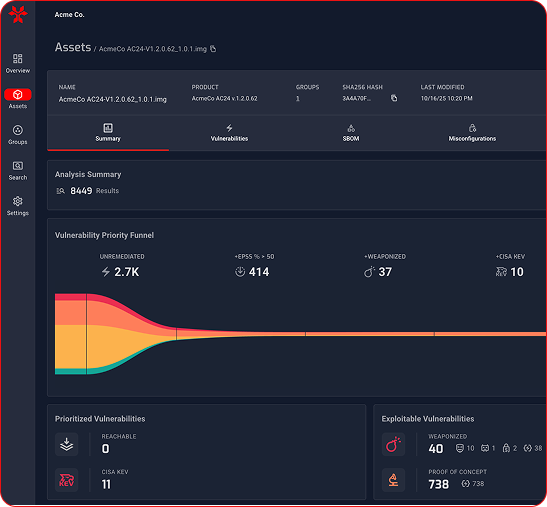
Most teams can produce documents.
Fewer can produce evidence tied to the production build.
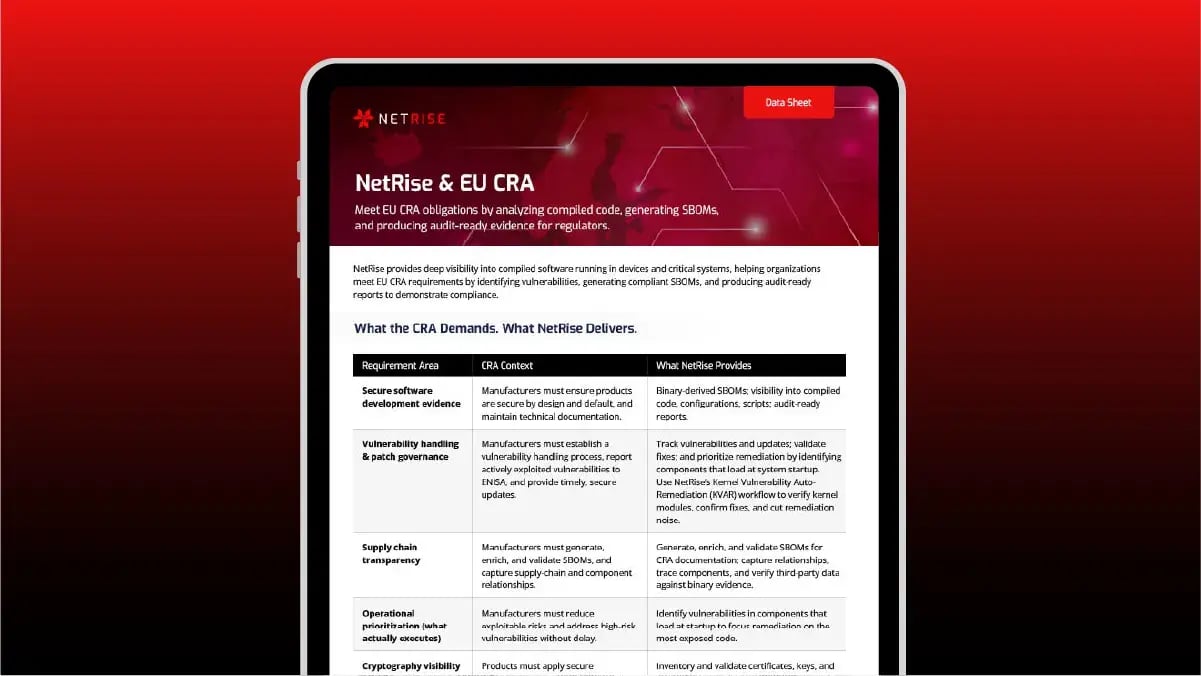
EU CRA readiness depends on an evidence trail you can defend. Get the NetRise EU CRA Overview eBook for scope, timelines, and reporting duties—plus practical examples.

Examples of products that commonly fall under CRA
If it forms part of your product with digital elements, or is a remote data processing solution essential to its function, assume it needs to show up in your CRA evidence trail.

Devices
Connected appliances and consumer electronics, industrial/IoT devices and gateways, network-connected embedded systems

Software
On-device firmware and operating systems, desktop and mobile applications shipped as part of the product, remote data processing solutions that are essential to product functionality

Components
Libraries and third-party packages shipped with products, drivers, modules, plugins, open source dependencies included in release builds
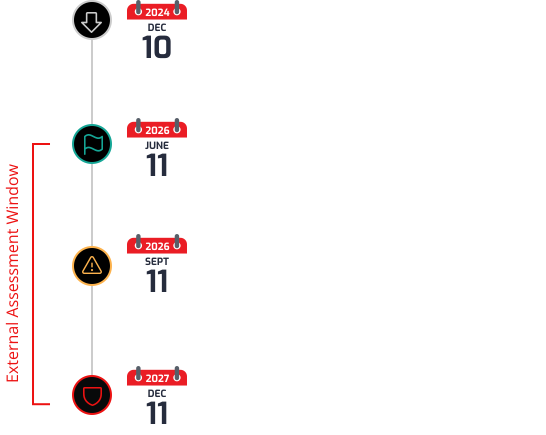

When do CRA requirements take effect?
CRA obligations roll out in phases. You should plan to be ready to provide evidence early, especially if you’ll need external assessment support.

What This Means for EU CRA (ENISA) Reporting Readiness
CRA reporting to the European Union Agency for Cybersecurity (ENISA) can require fast action windows:
- Early warning within 24 hours
- Detailed notification within 72 hours
- Final report within 14 days for actively exploited vulnerabilities (after corrective measures are available)
- Report within one month for severe incidents
Further Reading & Guidance
For organizations preparing for the EU Cyber Resilience Act (CRA), the following resources summarize scope, timelines, and reporting expectations:

CRA readiness spans security, compliance, engineering, and procurement. NetRise returns results in minutes and integrates with your pipelines across Linux, Windows, and RTOS.
Ready to See the NetRise Platform?
PQC compliance starts with knowing what’s vulnerable. See how NetRise deliverscryptographic insight across firmware, software, and embedded systems.