


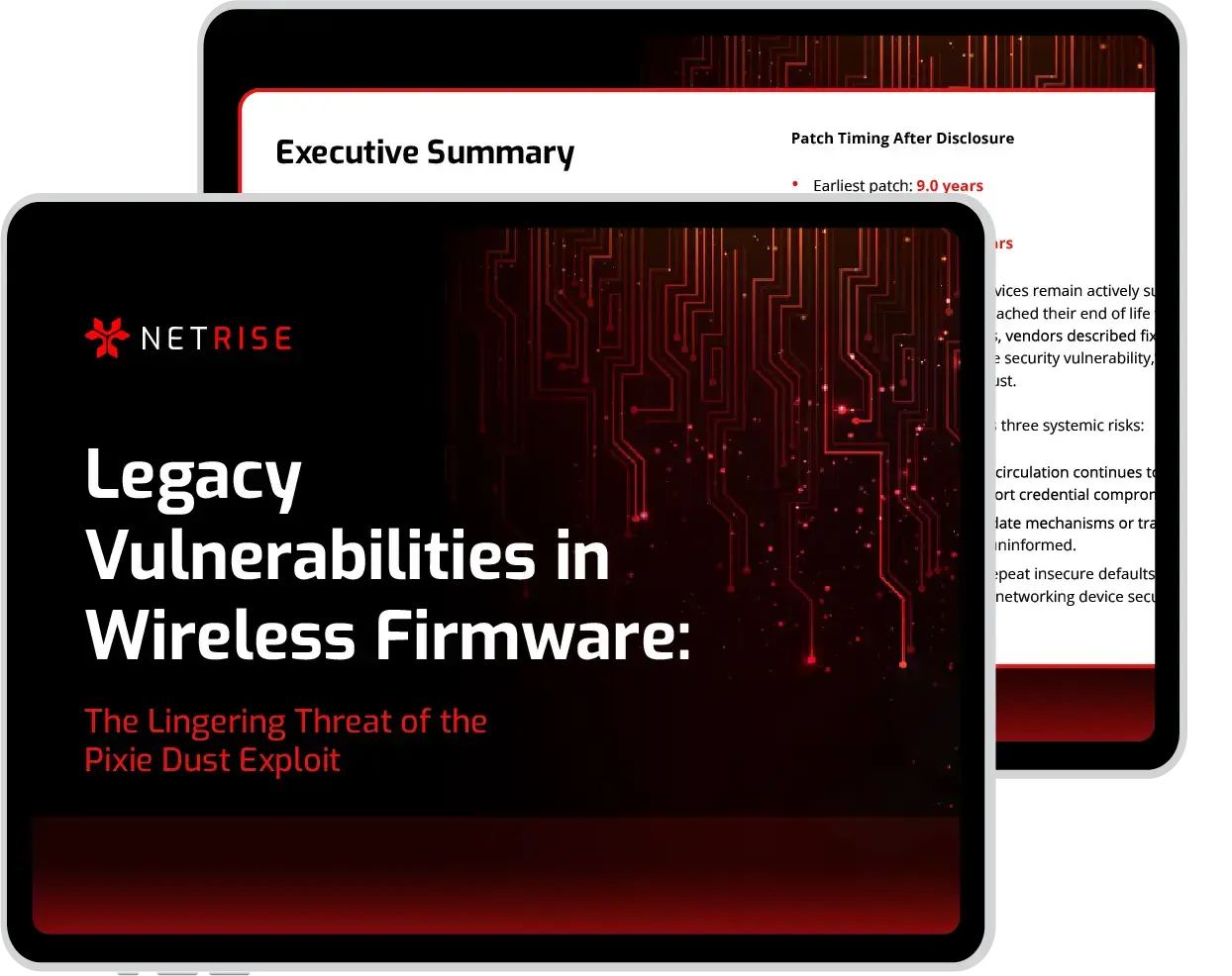
Why This Report Matters

Limited Vendor Transparency
Hidden Firmware-Level Risk
Repeated Supply Chain Weaknesses
What You’ll Learn in This Report:
Firmware supply chains don’t just inherit vulnerabilities — they preserve them. The persistence of Pixie Dust reveals systemic weaknesses that impact both OEMs and enterprises.
- SBOMs alone cannot capture vendored, statically linked, or legacy modules.
- Vendors shipped vulnerable firmware years after public disclosure.
- End-of-life devices never received fixes, leaving long-tail exposure in the field.
- Regulatory and operational risk is amplified by poor patch practices.

Hidden Risks in Wireless Firmware
Pixie Dust, first disclosed in 2014, continues to expose consumer and small-business networking devices in 2025. Across six major vendors, we identified 24 devices still vulnerable , with average patch delays of nearly 10 years . Many products remain actively supported yet unpatched, underscoring systemic risks in firmware supply chains.
- Vulnerable firmware releases as late as 2025
- Average patch lag: 9.6 years
- Only 4 of 24 devices were ever patched
- 13 devices remain supported but vulnerable

Why NetRise Conducted This Analysis
A hobbyist rediscovering Pixie Dust in 2023 showed this wasn’t a dead exploit. With NetRise’s firmware repositories and binary analysis tooling, that one-off observation became a defensible dataset spanning multiple vendors and nearly a decade of releases.
Binary analysis makes these legacy flaws visible when vendor disclosures and package manifests do not.