

BlogPartners

Solution Brief

NetRise for Telecom Software Development: Solution Brief on Software Supply Chain Security

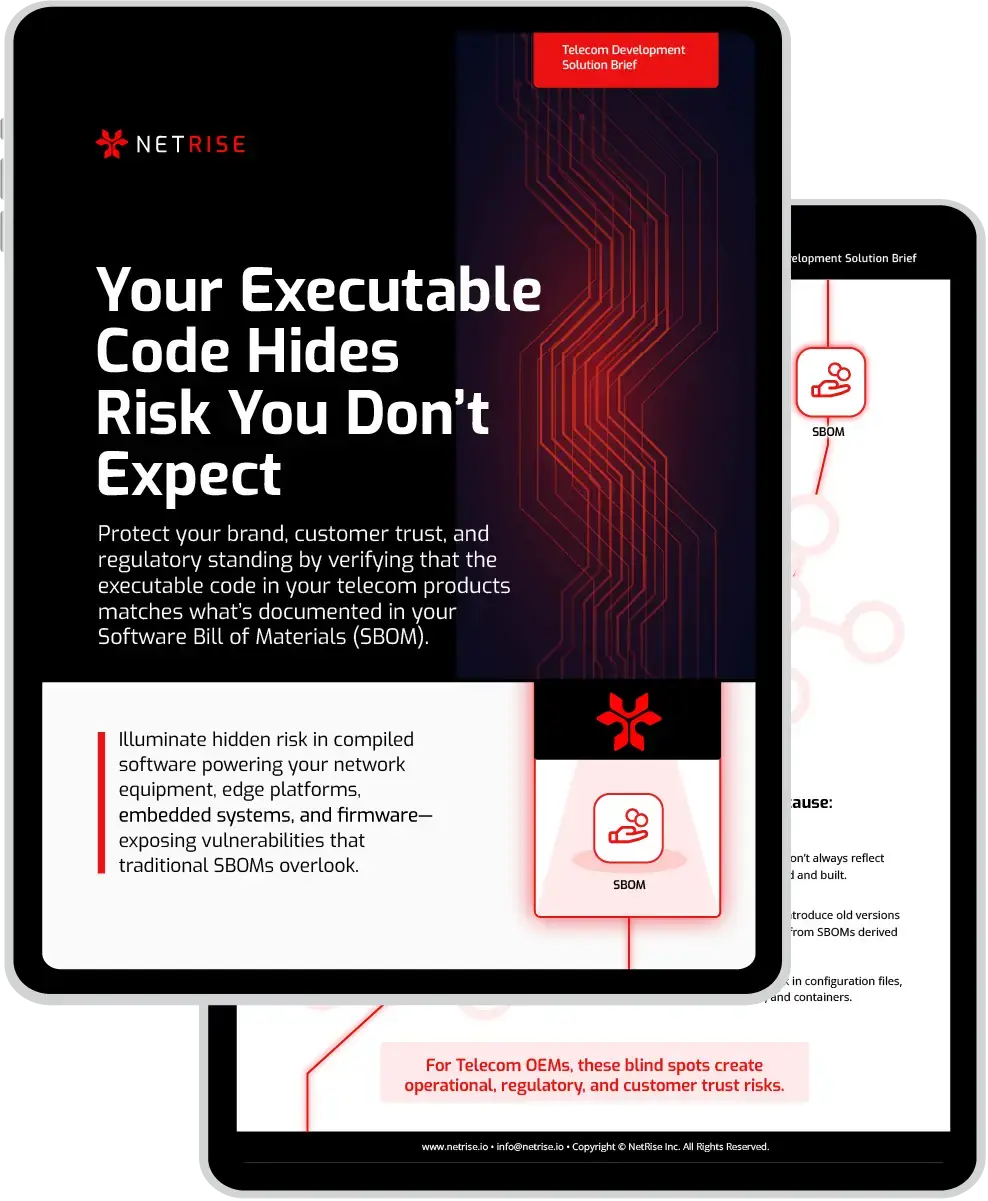
Protect your brand, customer trust, and regulatory standing by validating that the compiled code in your telecom products matches what your SBOM declares—and by uncovering the hidden risk traditional tools overlook.

Download the Solution Brief
netrise-telecom-oem-solution-brief-ft

The Challenge

See What’s Really Inside the Software You Ship

Telecom OEMs and software developers rely on SBOMs, SCA, and AST tools to validate product integrity. But after code is built, packaged, and deployed into network equipment, edge compute platforms, and embedded systems, visibility disappears. The NetRise Telecom Development Solution Brief explains how analyzing compiled software—rather than relying solely on manifests or attestations—exposes hidden components, validates SBOM accuracy, and strengthens trust with operators, regulators, and partners.

question-mark-icon

Do the component versions in the software build actually match those in your manifest?

These gaps persist because

icon-checklist

Static testing and SCA don’t always reflect what’s actually compiled and built.

NetRise delivers the visibility and context needed to build, certify, and ship secure telecom software and devices.

Why You Need a Comprehensive SBOM

Software today is more assembled than written. Research shows that as much as 80% of today’s software is comprised of third-party components. A single application can include proprietary code, open-source libraries, config files, operating systems, credentials, and more.

The Solution

Software Supply Chain Security for Telecom OEMs

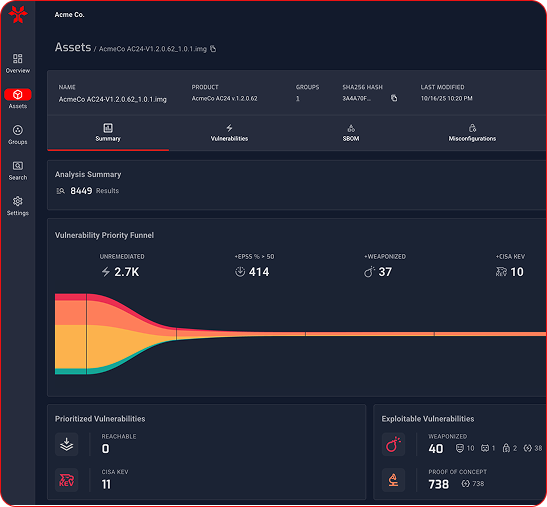
NetRise gives telecom OEMs complete visibility into the software you build—across devices, applications, and vendors—so you can uncover hidden risk, strengthen regulatory defensibility, and make faster, more informed security decisions. Unlike legacy tools limited to source-code analysis, NetRise analyzes the software that actually executes in your products, providing the clarity to prioritize action and reduce exposure.
NetRise-Turbine-Screenshot-Square

Who the Telecom Development Solution Brief Is For

  • Telecom OEM application, platform, and embedded developers

  • DevSecOps and CI/CD engineering teams

  • Product Security / PSIRT organizations

  • Architecture & engineering leads for 5G and edge products

  • Compliance and regulatory teams supporting telecom security standards

Platform Overview

  • logo-star

    Binary Composition Analysis

    Reveal hidden components, legacy libraries, configuration artifacts, and build-time additions.

  • Software Composition Transparency

    Understand everything inside your software, including third-party modules and bundled systems.

  • Software System of Intelligence

    Enrich findings with exploitability, runtime execution, and weaponization context.

  • Compliance & Evidence Generation

    Support global telecom regulatory requirements with binary-derived SBOM accuracy.

  • Cross-Environment Coverage

    Analyze compiled code from embedded systems, network gear, virtual platforms, and edge compute.

Why NetRise Stands Apart

  • icon-alert

    Exploit-Aware Prioritization

    Focus on real risk with vulnerability intelligence enriched by exploit data, privileges, and CVSS impact.

  • icon-numbered-list

    Reachability Insights

    Identify components that autorun or initialize at startup to prioritize remediation.

  • icon-exchange

    Kernel Vulnerability Auto-Remediation

    Eliminate kernel vulnerability noise with automated validation and VEX-compliant evidence so teams can focus on exploitable issues and simplify audits.

  • icon-key

    Non-CVE Risk

    Surface non-vulnerability risk around misconfigurations, credentials, keys, and licenses.

  • icon-puzzle

    Seamless Integrations

    Automate workflows across ticketing, compliance, SIEM, and asset management via robust APIs.

Common Challenges Telecom OEM Developers Face

Challenge

Build-time substitutions introduce older or vulnerable library versions that never appear in source-derived SBOMs.

How NetRise Helps

Generate complete binary-derived SBOMs that reflect compiled reality—not developer assumptions.

Challenge

Static linking pulls inherited components into binaries without developer visibility.

How NetRise Helps

Validate that builds match manifests and detect unauthorized changes or injected components.

Challenge

Transitive and third-party dependencies bring along modules that SBOMs fail to capture.

How NetRise Helps

Prioritize real risk using exploit-awareness, reachability, privilege context, and kernel auto-remediation.

Challenge

Hidden artifacts—such as credentials, config files, and cryptographic materials—sit outside AST/SCA coverage.

How NetRise Helps

Uncover non-CVE risks like misconfigurations, hard-coded secrets, and exposed private keys.

Challenge

Regulatory expectations now demand proof of what actually shipped, not what was declared.

How NetRise Helps

Produce audit-ready evidence aligned with telecom security frameworks and regulatory expectations.

Ready to Verify What’s Really Inside Your Telecom Software?

Download the Telecom Development Solution Brief to see how NetRise helps engineering teams validate SBOM accuracy, uncover hidden software supply chain risk, and deliver secure, trustworthy telecom products.