





Product Security
Product Security For The Software You Build
You answer for every component in the release, including those no one on your team wrote or reviewed.
With NetRise, know exactly what’s in every release: what you ingested, what actually compiled, and what to fix — before it ships under your name.
The Challenge
You Own The Release. AI Is Writing More Of What’s In It.
Open-source packages, their dependencies, AI-generated code, and the firmware and OS layers beneath them make up most of what you ship — all under your product's name, and more than your SCA tools alone can scan.
Where Build-Side Tools Stop Short
SCA Scanners
Read declared dependencies in source; don’t confirm what the build actually included.
Source-derived SBOMS
Describe what was declared, not the compiled artifact your customers receive.
CVE-based tooling
Flags known vulnerabilities, not the secrets, keys, and misconfigurations shipped with the artifact.
Firmware & OS-layer tooling
Stops at the application layer; misses the kernels, RTOS, drivers, and firmware you inherit and ship.
With NetRise
Evidence At Every Stage Of The Build
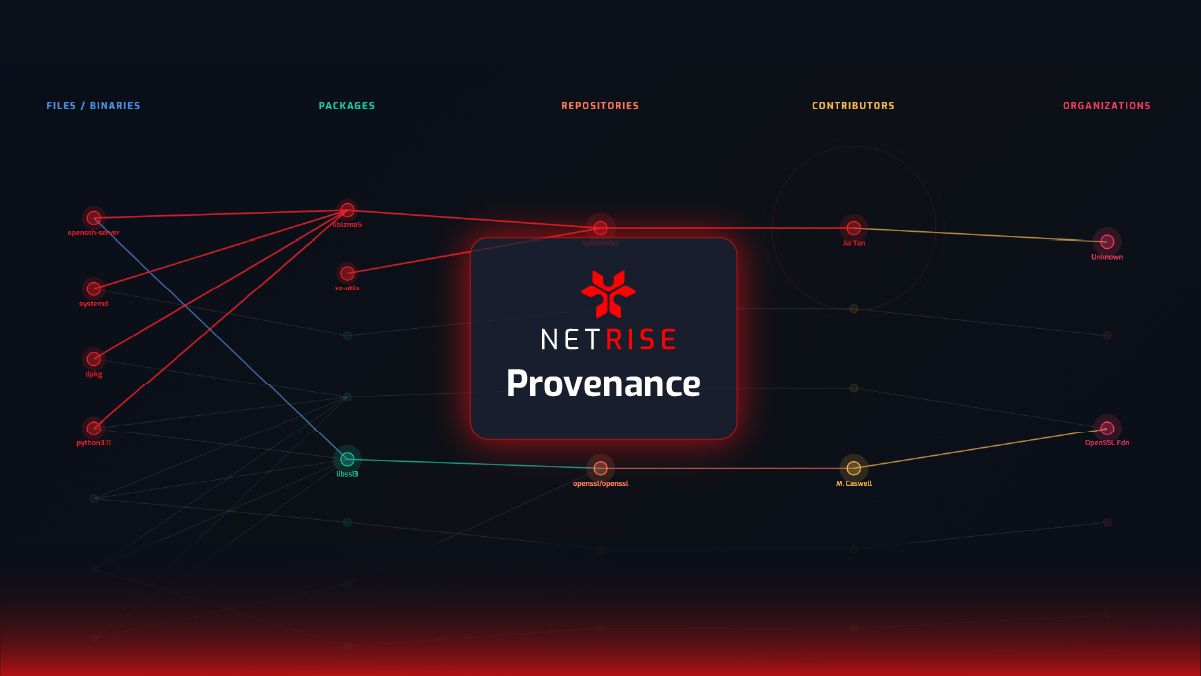
Should this package enter the build? NetRise Provenance® applies one consistent trust standard and keeps malicious packages out with Package Firewall Manager.
What actually compiled in, including what no manifest declared? NetRise Turbine® analyzes the compiled artifact — application code, third-party components, and the layers beneath them: kernels, RTOS, drivers, and firmware — surfacing statically linked libraries, vendored dependencies, and the non-CVE risk scanners miss: embedded secrets, exposed keys, and misconfigurations.
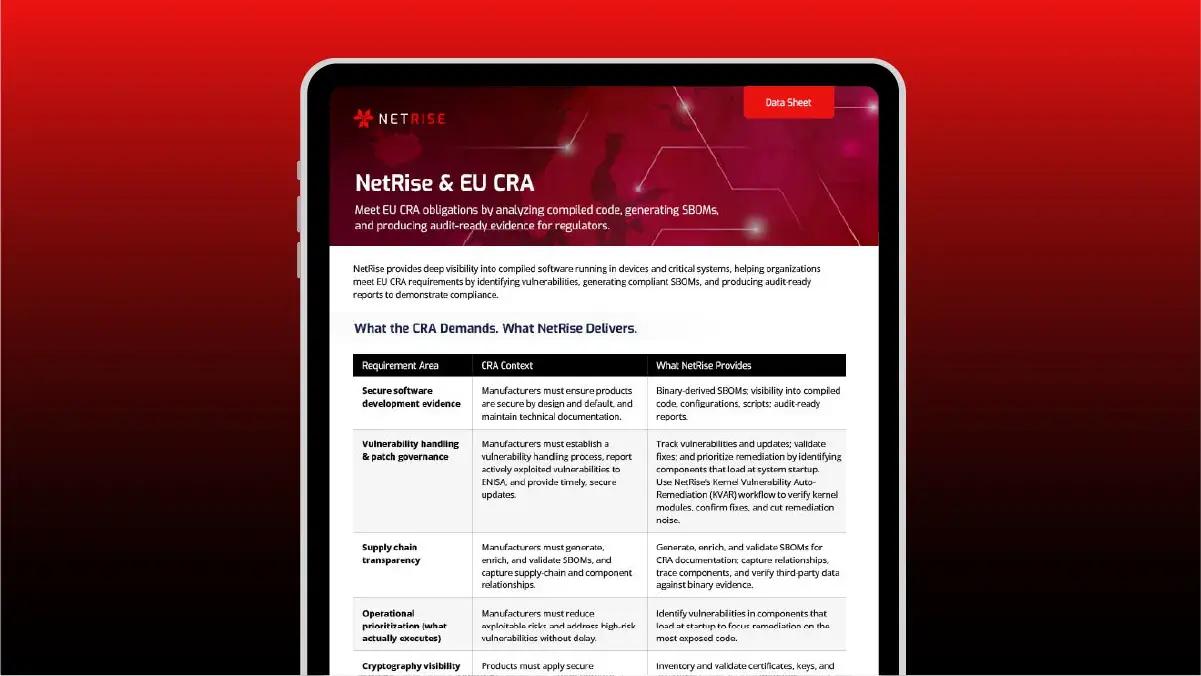
Does the artifact match what you intended to ship, and can you prove it? Turbine produces a build-true SBOM you can hand to customers and regulators.
A component you shipped goes bad. Which products and versions are affected? Provenance blast radius scopes propagation across your builds in minutes, so the answer is on file, not assembled by hand.
The Solution
Two Products. One Complete Answer.
Provenance determines whether software should be trusted before it enters your build and traces how far risk propagates once a dependency turns. Turbine independently verifies what actually compiled into the release — components plus the secrets, keys, and misconfigurations no manifest lists — with no source code required.
NetRise Turbine
Turbine doesn’t infer risk from a manifest. It analyzes the compiled artifact directly: components, credentials, and the paths a system entry point can reach, so you can act:
- What’s Inside? — The actual component inventory, including statically linked and embedded dependencies that no manifest declared.
- Is it Reachable? — Whether a traceable execution path connects a system entry point to the affected component, so you prioritize risk that can actually be reached.
- What non-CVE risk is present? — The exposed secrets, keys, and misconfigurations shipped in the artifact that a CVE scan never surfaces.
What Turbine sees in the artifact:
- 3×more reachable vulnerabilities via deep execution-graph analysis
- 10k+kernel-CVE findings auto-resolved per scan
- 13kcertificates and 128 private keys in one patched device — not one a CVE
NetRise Provenance
Provenance maps every dependency to its origin and traces how far its risk reaches, scoring each on three dimensions. Package Firewall Manager then blocks what fails wherever code enters — even the packages your AI assistant suggests:
- What’s the Impact? — How far a risky package or maintainer reaches across your builds and products.
- Is the Repository Healthy? — Whether the project behind it is active and maintained, or decaying.
- Who’s Involved? — Who maintains it, where they’re based, and whether they’re tied to known risk.
What Provenance maps across the supply chain:
- 3M+open-source repositories tracked
- 10M+packages mapped to upstream sources
- 100M+components marked, with organization and geographic data
NetRise Provides Product Security Results You Can Measure
Block risky and malicious packages before they enter a build.
Produce build-true SBOMs for customers and regulators.
Reduce vulnerability noise by more than 90% with reachability analysis.
Tell customers which products and versions are affected in minutes, not weeks.
Ready to Verify What Goes Into Your Builds?
FAQ
How do you secure software your team didn’t write?
Most of what you ship comes from open-source packages, their dependencies, AI-generated code, and the firmware and OS layers beneath them. NetRise analyzes the compiled release artifact for independent evidence of what’s actually inside — components plus the secrets, keys, and misconfigurations no manifest lists — so you can verify what ships under your name.
What is execution-aware reachability?
It traces execution through the compiled artifact — from system entry points into the binaries that run, the libraries they load, and the credentials they reference. Each finding is classified as Exists, Reachable, or Executes, so your team prioritizes risk that can actually run instead of working a flat CVE list.
What is a build-true SBOM?
A build-true SBOM is derived from the compiled artifact you actually ship, not from source manifests that describe intent. NetRise Turbine produces build-true SBOMs you can hand to customers and regulators, with no source code required.
How do you find risk that isn’t a CVE?
CVE-based tooling flags known vulnerabilities but misses embedded secrets, exposed keys, and misconfigurations in the artifact — along with risk in the kernel, RTOS, drivers, and firmware beneath the application layer. NetRise surfaces this non-CVE risk directly from the compiled binary.