






THIRD-PARTY RISK MANAGEMENT
Reduce Third-Party Risk by Verifying Vendor Software
You're accountable for vendor software you can't inspect — so their unknown risk quietly becomes yours, and you find out during the incident.
NetRise adds independent evidence to your TPRM program: what's actually inside vendor software, whether patches add risk, and how far exposure reaches when incidents hit.
The Challenge
Your Vendor Assessments Are Only as Good as What Vendors Tell You.
TPRM programs run on questionnaires, ratings, and self-attested SBOMs — what vendors report at a point in time, not what they ship or what changes after. NetRise adds continuous monitoring of what's actually inside vendor software, so you answer "where are we exposed?" in minutes and stay resilient as new risk emerges.
Where Vendor-Reported Evidence Stops Short
Security Questionnaires
Capture what a vendor chooses to disclose, at a single point in time.
Ratings & Outside-in Scores
Reflect externally observable risk, not the software components, credentials, or configurations inside the product.
Vendor Attestations & SBOMs
Describe what the developers declare, decay with every patch, and can't be checked against what actually shipped.
Manual Incident Scoping
When a vulnerability is disclosed, confirming which vendors' products contain it means tracing it by hand across spreadsheets and questionnaires.
With NetRise
Evidence Across the Vendor Lifecycle
Assess a vendor before you approve it. NetRise Turbine® analyzes not only the vendor's application software, but also the actual firmware and other artifacts - the software the vendor ships, including non-CVE risk - on the product, so the review starts with everything that’s inside instead of a questionnaire.
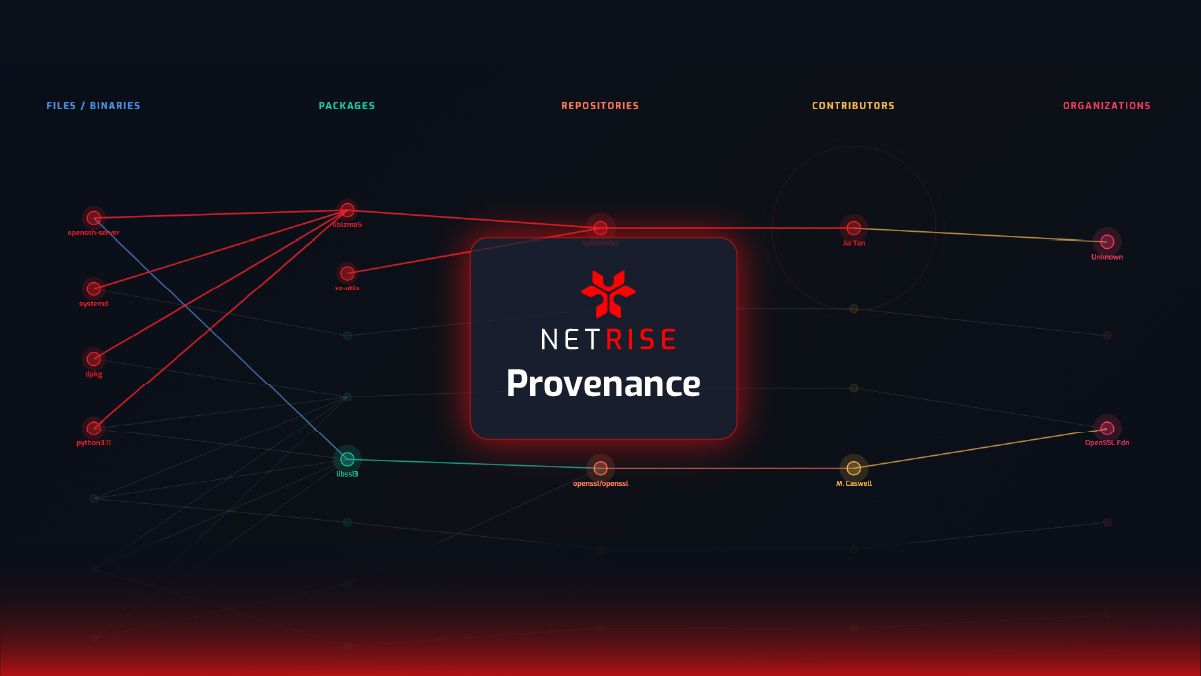
Judge whether the software can be trusted. NetRise Provenance® evaluates the open-source components inside vendor software, including whether projects are actively maintained, depend on too few maintainers, or show other indicators of supply chain risk, so you can make more informed decisions before you buy.
Most vendor assessments capture a point in time. NetRise continuously monitors the software vendors actually ship, so your assessment stays current as software changes.
When a new vulnerability is disclosed, which vendors' products actually contain the affected component? Turbine confirms its presence across analyzed assets, and Provenance maps how far it reaches, so you know your exposure and can set policies and controls in minutes instead of tracing it manually.
The Solution
Two Products. One Complete Answer.
Turbine independently verifies what's inside the software a vendor shipped you, with no source code required. Provenance determines whether that software should be trusted and traces how far a new risk reaches across your vendors and products. Together they strengthen your third-party risk program with evidence you control, instead of relying on vendor self-attestation.
Is the risk real, or just present?
Not every vulnerability in a vendor's software is exploitable. Turbine analyzes the delivered software and separates what's merely present from what's actually exploitable, so you focus on real risk.
- Present — the component is in the vendor's software.
- Reachable — it's actually exposed and can be used, not just sitting in the software they shipped.
What that surfaces in real vendor software:
- 100sexploitable vulnerabilities found in a shipped enterprise appliance, from the software itself, with no vendor cooperation
- 10k+kernel and firmware CVE findings cleared automatically per analysis — the layer questionnaires never reach
- 13kcertificates and 128 private keys shipped in one patched device — not one of them a CVE
A component is compromised. Are you affected?
A compromised component rarely stops at one vendor. Provenance traces it into the third-party products, devices, and software you actually have — so you know whether you're affected, and where.
- Extent of exposure — which of your vendor products and assets contain the compromised component, the moment it's identified.
- Repository health — whether the project behind a component is maintained or decaying.
- Who's behind it? — the maintainers and organizations behind it, where they're based, and whether they're tied to known risk.
The scale behind that answer:
- 3M+open-source repositories tracked
- 10M+packages indexed to their upstream sources
- 100M+contributors tracked, with organization and geographic data
TPRM Results You Can Measure
Start vendor assessments with independent evidence, not questionnaires.
Identify exposure across vendors and products in minutes when an incident hits.
Continuously monitor vendor software as it changes.
Strengthen supply chain resilience with faster detection and response to vendor incidents
"Trust Me" Is a Pinky Promise, Not a Control.
FAQ
How does NetRise support third-party risk management?
NetRise augments your third-party risk program with independent evidence from the software vendors actually ship. NetRise Turbine verifies what's inside a vendor's firmware, appliance, or application from the software the vendor ships; NetRise Provenance evaluates whether that software should be trusted and maps how far a new compromise reaches across your vendors and products.
How is this different from security questionnaires and ratings?
Questionnaires and ratings capture what a vendor reports and what its perimeter looks like, at one point in time. NetRise analyzes the vendor's actual software to confirm what's inside — including components below the application layer — so assessments start with verifiable facts instead of self-attestation.
Can NetRise assess vendor software without the source code?
Yes. NetRise analyzes the compiled software the vendor ships — no source code or vendor cooperation required — which means you can validate firmware, appliances, and commercial applications you could never review from source.
How does NetRise help during a software supply chain incident?
When a disclosure lands, NetRise confirms which vendors and products actually contain the affected component and maps how far the risk propagates with blast radius analysis — so you can scope exposure in minutes instead of assembling it by hand across questionnaires and spreadsheets.
How does NetRise support software supply chain resilience?
Resilience depends on knowing what you actually run and recovering fast when something goes wrong. NetRise gives your third-party program independent evidence of what's inside vendor software and maps how far a new risk reaches — so you can absorb a supply chain incident and respond in minutes, not days.