





CRITICAL INFRASTRUCTURE
The Failure Is Physical. The Risk Is in the Software.
Grid relays and inverters, pipeline SCADA, water treatment PLCs, clinical devices, network cores. Different sectors, one shared condition: the software inside was written by someone else and assessed by nobody.
NetRise analyzes the compiled firmware and software inside operational assets — no agent, no probe, no vendor involvement — so exposure is known before an outage makes it public.
The Challenge
Most Mandates Don't Bind You. The Physics Still Do.
Executive orders bind federal agencies, not you. The equipment running your operation was still assembled from open-source and third-party code nobody assessed, and it will stay in service for decades. A failure there arrives as an outage, a safety event, or a regulator asking why.
Where Operational Security Tooling Stops Short
Endpoint agents
Cover the IT estate. Controllers, PLCs, and embedded devices have no supported way to install an agent.
Network monitoring
Identifies a device by the model and firmware version it reports, not by the code compiled inside it.
Vendor advisories
Arrive on the manufacturer's schedule, naming the products the manufacturer chooses to name.
Supplier questionnaires
Survey a vendor's own security program, never the open-source code inside the product they sold you.
WITH NETRISE
What the Artifact Will Tell You
NetRise Turbine® analyzes the firmware image or software package itself, across 200+ artifact types. Nothing is installed and nothing is probed, so assets no vulnerability report has ever listed can finally be assessed.
Maintenance windows are scheduled, not continuous. Turbine separates present components from those a live execution path reaches, then weighs what remains against KEV status and weaponization. The window goes to findings that can be exercised.
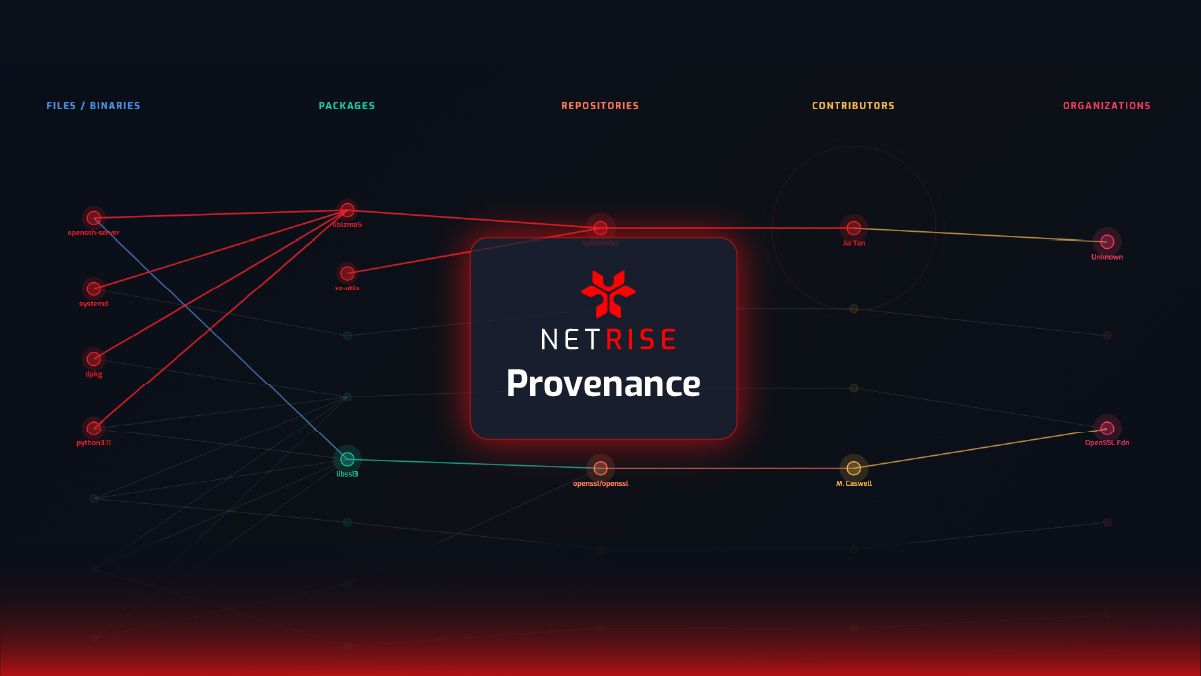
The cheapest moment to reject a device is before installation. Turbine reads the delivered artifact, checking supplier SBOMs against what the firmware contains, and NetRise Provenance® assesses whether the open-source inside deserves trust.
When a disclosure names a component rather than a product, Provenance traces how far it propagates across the libraries, products, and vendors around it, and Turbine identifies which of your assets actually carry it.
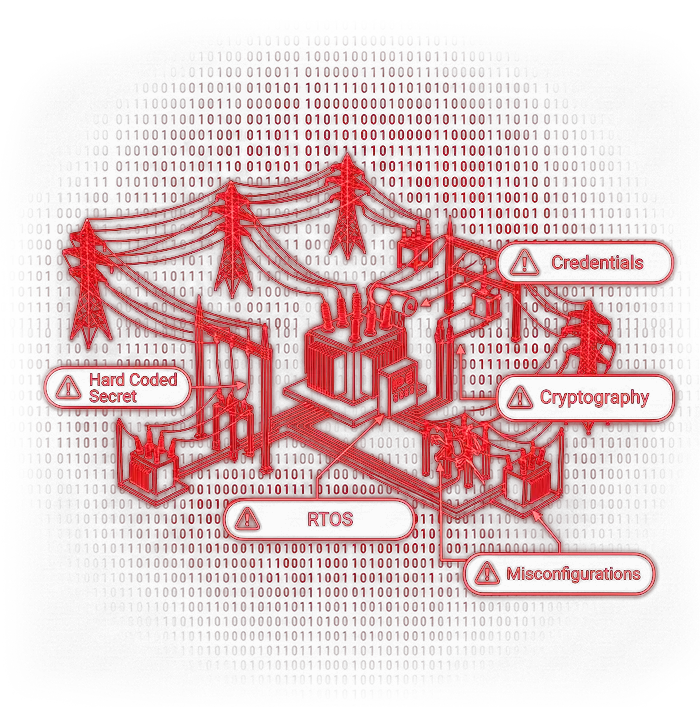
Hard-coded accounts, shared keys, expired certificates, and quantum-vulnerable cryptography ship inside operational firmware more often than anyone documents. A credential reused across a device family is a fleet-wide exposure, not a single finding.
THE SOLUTION
Two Products. One Complete Answer.
Operators receive a sealed artifact and a specification. Turbine opens the artifact and establishes what a supplier actually compiled in — components, credentials, cryptography — with no source code and no vendor involvement. Provenance assesses whether the open-source inside can be trusted and, when a package is implicated, identifies which equipment inherits it. What justifies taking a system offline comes from the software, not the release notes.
A finding isn't the same as a threat.
Most vulnerabilities inside an operational asset will never execute. Turbine determines which a live path can reach — the difference between a remediation list a maintenance window can absorb and one that guarantees something important gets skipped.
- Present — the component was compiled into the artifact a supplier delivered.
- Reachable — running code loads it, which is what earns a place on the work order.
What that looks like at scale:
- 833vulnerabilities proven reachable out of 125,575 identified across 40 analyzed assets
- 200+artifact types analyzed, including embedded Linux, RTOS, containers, and applications
- 0agents installed, probes sent, or processes touched; analysis runs against the image
One package is implicated. What else is?
A compromised component rarely stops at one device model. Provenance maps direct and transitive relationships across ecosystems, identifying the libraries, products, and vendors the risk propagates into, including paths that never surface inside any single image.
- Which equipment carries it — the assets holding the implicated component, named rather than surveyed for.
- Whether the project is still maintained — active development, or a repository sliding toward abandonment with nobody left to issue a fix.
- Who the maintainers are — the individuals and organizations behind the code, the regions they operate from, and whether any appear in threat reporting.
The scale behind that answer:
- 3M+open-source repositories indexed
- 10M+packages resolved to their upstream sources
- 100M+contributors profiled by organization and geography
Critical Infrastructure Results You Can Measure
Inventory operational assets that cannot host an agent or tolerate an active scan.
Rank remediation by what running code reaches, sized to a scheduled maintenance window.
Scope a newly disclosed vulnerability across the estate in a single query.
Produce component evidence tied to specific deployed assets for auditors, insurers, and sector regulators.
What's Running Inside the Systems You Can't Take Offline?
Frequently Asked Questions
What does NetRise do for a critical infrastructure operator?
It analyzes the compiled firmware and software inside the equipment that runs your operation — controllers, RTUs, PLCs, HMIs, inverters, battery systems, historians, engineering workstations, gateways, clinical devices, network elements, and the applications around them. Turbine establishes what a supplier actually compiled into the artifact, including components, hard-coded credentials, and cryptography, and determines which vulnerable components running code can reach. Provenance assesses whether the open-source inside can be trusted and traces how far a compromise propagates.
Is critical infrastructure required to comply with federal software supply chain mandates?
Usually not directly. Executive orders and binding directives place obligations on federal agencies; critical infrastructure owners and operators are typically named as beneficiaries, with sector risk management agencies and CISA directed to assist rather than require. Sector-specific regulators are a separate matter, and several do impose binding requirements — NERC CIP on the bulk electric system, TSA security directives on critical pipelines, FDA premarket expectations on medical devices.
Can NetRise analyze equipment we can't take offline or install anything on?
That is the case it exists for. Analysis runs against the firmware image or software package itself, so nothing is installed on the device, nothing is probed over the network, and the running process is never touched. Safety systems, air-gapped segments, and legacy equipment can all be assessed the same way.
How do we get firmware for equipment we didn't build?
Most operators already hold supplier firmware from update packages, spares provisioning, or support portals. Those images are what gets analyzed. No source code and no supplier participation is required, which means a vendor's willingness to cooperate is not a prerequisite for assessing its equipment.
Our equipment is fifteen years old and the vendor is gone. Can it still be assessed?
Yes, and that is often where the worst findings are. Analysis works from the artifact, so a discontinued product with no support contract and no one left to ask can be inventoried as completely as a current one — including end-of-life components and cryptography that has aged out.
Which sector does my organization fall under?
The analysis does not change by sector, but the regulatory framing and the equipment do. Sector pages cover energy, healthcare, communications, financial services, government, and the manufacturers supplying all of them.
Why does it matter who maintains the open-source inside our equipment?
Because a supplier's support commitment doesn't extend to the projects it inherited. A controller can be fully supported by its manufacturer while the library handling its cryptography has one maintainer and no commits in two years. Provenance identifies the organizations behind those components, the regions they operate from, and whether a project is drifting toward abandonment — so equipment risk accounts for the parts nobody signed a contract for.