




APPLICATION SECURITY
Application Security Beyond SAST and SCA
Your SAST and SCA tools see source and manifests. But linkers and vendored copies change the build, so a clean manifest can still ship vulnerable code.
NetRise adds independent evidence from the artifact you ship: the components, weaknesses, secrets, and misconfigurations inside it, so pipeline posture matches production reality.
The Challenge
Your Pipeline Analyzes the Source. Production Runs the Artifact.
SAST, SCA, and CI checks (Snyk, Checkmarx, Veracode) read source, manifests, and CVEs before the build. That secures what you intend to ship, not what the build produced: statically linked libraries, vendored copies, and late-injected secrets.
Where Source-Based Evidence Stops Short
SAST
Inspects source for security flaws before the build; it can't always see which library version the linker binds into the compiled artifact.
SCA
Parses manifests and package managers, reporting the declared version, not the vendored or statically embedded copy the build pulled in.
Package trust & provenance
Verifies a declared package resolves, not whether the project behind it is trustworthy — repository health, maintainer risk, or a compromised release entering the build.
CVE-only dependency risk
Flags known CVEs in declared packages; misses non-CVE weaknesses (CWEs), embedded secrets, and cryptographic material baked into the binary.
With NetRise
Evidence Across the Build-to-Ship Lifecycle
Before you ship, confirm the artifact matches the pipeline. NetRise Turbine® analyzes the compiled container, firmware image, or application binary and identifies the components inside it, including the statically linked and vendored dependencies no manifest lists.
Stop the risk before it's in the build. The NetRise Provenance® Package Firewall Manager blocks compromised and policy-violating packages at intake and in CI/CD — including those pulled in by AI coding assistants — before they reach the codebase.
Act before a flaw gets a CVE. NetRise ZeroLens® analyzes compiled code for CWE-class weaknesses that carry no CVE yet, alongside the hard-coded secrets, keys, and misconfigurations shipped in the binary.
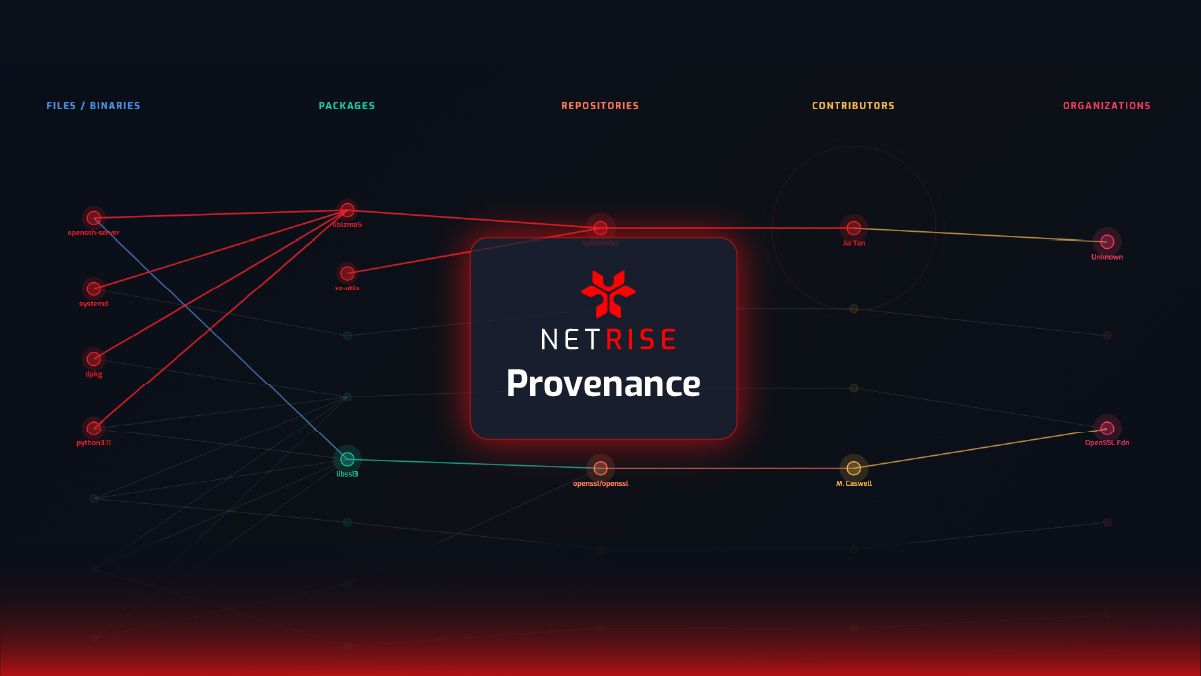
Decide which components to trust, deprecate, or monitor. Provenance maps the open-source components in the artifact back to their source repositories, maintainers, and risk signals.
The Solution
Two Products. One Complete Answer.
Turbine independently verifies what the build put inside your artifact, with no source code required. Provenance evaluates the open-source components behind that software and maps how far a new risk reaches across your applications. Together they anchor your AppSec program in the software that ships.
What ships that no CVE will flag?
Sometimes, the most serious risk in a compiled artifact is never assigned a CVE. Turbine analyzes what the build actually produced and surfaces the weaknesses, secrets, and misconfigurations an SCA report can't.
- Non-CVE weaknesses (CWEs) — in compiled code, discovered by NetRise ZeroLens: high-risk flaws you can act on before they become a zero-day.
- Secrets — hard-coded API keys and access tokens injected late in the build or inherited from base images.
- Misconfigurations — default credentials and weak Transport Layer Security (TLS) frozen into compiled services.
What Turbine sees in the artifact:
- 100sreachable vulnerabilities surfaced by deep execution-graph analysis
- 10k+kernel-CVE findings cleared automatically per analysis
- 13kcertificates and 128 private keys in one patched device — not one a CVE
Which components can you trust?
Provenance maps every dependency to its origin and answers whether to trust it — scoring each on three dimensions. Package Firewall Manager blocks compromised and policy-violating packages before they enter your build, including those pulled in by AI coding assistants:
- What's the impact? — How far a risky package or maintainer reaches across your applications and assets, the moment it's identified.
- Is the repository healthy? — Whether the project behind a component is active and maintained, or decaying.
- Who's behind it? — The maintainers and organizations behind a component, where they're based, and whether they're tied to known risk.
What Provenance maps across the supply chain:
- 3M+open-source repositories monitored across the ecosystem
- 10M+packages linked to the sources they came from
- 100M+components profiled by organization and region
AppSec Results You Can Measure
Verify that SCA-reported dependency versions match what's compiled into the artifact.
Catch statically linked, vendored, and generated components that never appear in a manifest.
Block risky and malicious packages before they enter a build — including those pulled in by AI coding assistants.
Give leadership a defensible view of where risk resides in the software you ship.
Ready to Verify What You Ship?
FAQ
How does NetRise support application security?
NetRise augments your application security program with independent evidence from the compiled artifact you ship. NetRise Turbine identifies the components, non-CVE weaknesses, secrets, and misconfigurations inside a container, firmware image, or application binary; NetRise Provenance evaluates the open-source components behind it and maps how far a new risk reaches.
Does NetRise replace SAST and SCA?
No. SAST, SCA, DAST, and IAST stay core to how you design, build, and test software. NetRise strengthens the layer they depend on: trust in the artifact that actually ships. It pairs with your existing stack, anchoring pipeline results in compiled-code evidence rather than replacing your tools.
Why do SAST and SCA miss vulnerabilities in compiled software?
SAST and SCA analyze source code and dependency manifests before the build. Static linking, vendoring, generated code, and firmware packaging change what ends up in the artifact afterward. The result: a manifest can read "patched" while the binary still carries a vulnerable, statically embedded copy of the same library.
What is binary composition analysis in application security?
Binary composition analysis identifies the components inside a compiled artifact — including statically linked libraries, vendored code, and transitive dependencies that never appear in a manifest. For AppSec teams, it produces a software inventory grounded in what's actually present in the artifact, not what the repository declares.
Can NetRise find risk without the source code?
Yes. NetRise analyzes the compiled artifact you already ship — no source code or vendor cooperation required — so you can validate containers, firmware images, and application binaries against what your pipeline reported.