






FINANCIAL SERVICES
Your Institution Runs on Code You Didn't Write
Customer apps, network infrastructure, trading systems: all run on code your institution didn't write, and PCI DSS 4.0 and the SEC cybersecurity rules both expect you to account for it.
NetRise works from the compiled software itself — the apps your teams ship, the infrastructure they run on, and the trading and banking systems behind them — surfacing risk and the evidence auditors ask for.

The Challenge
Someone Else Wrote the Software Moving Your Money. The Liability Is Still Yours.
Software today is assembled more than written — as much as 80% of a codebase comes from open-source someone else maintains. That's true of the customer apps your developers ship, the network infrastructure underneath them, and the trading and banking platforms you bought. When one of those components is compromised, your regulatory standing goes with it.
Where Financial Security Tools Stop Short
Vulnerability scanners
Match a device's installed software against known CVEs, but never open the compiled firmware inside ATMs and payment terminals.
Vendor attestations & SBOMs
Reflect a supplier's chosen disclosures, then decay quietly as each release shifts the dependency set underneath them.
Source-based testing (SAST/SCA)
Read the code a developer committed, not the compiled build that runs in production.
Manual incident scoping
Hand-tracing a newly disclosed vulnerability across banking, payments, and trading takes weeks while those systems keep running.
WITH NETRISE
Evidence Across the Financial Environment
GRC teams build regulator-facing evidence from vendor attestations and spreadsheets. NetRise Turbine® opens the compiled firmware you run, producing SBOMs tied to specific deployed systems, so PCI DSS 4.0 and NYDFS evidence rests on the software.
Evaluate procured technology before it reaches your environment. Turbine works from the artifact a supplier delivers rather than its self-attestation, and NetRise Provenance® assesses whether the open-source inside can be trusted — so procurement and M&A diligence rest on the software itself.
For the apps and tools your teams ship, Provenance checks every open-source package developers pull in, including ones an AI assistant added, and stops the known-bad and noncompliant. Turbine analyzes the compiled build for secrets and keys source scans miss.
Volume isn't the problem; prioritization is. Turbine narrows to the vulnerabilities a live path reaches, that initialize at startup, and that ransomware crews are known to use — so effort lands on what could actually take a customer-facing system down.
A vulnerability gets disclosed, and every system carrying that component keeps serving customers until you can prove which ones they are. Provenance traces how far it travels and Turbine names every affected asset — collapsing a multi-week reconciliation into a single session.
THE SOLUTION
Two Products. One Complete Answer.
Your institution didn't write most of its software. Turbine opens the compiled artifact and identifies the open-source inside. Provenance judges whether it can be trusted and, when compromised, which products inherit it. Evidence comes from the software, not an attestation.
Binary Evidence Answers
A finding isn't the same as a threat.
Most vulnerable code inside a financial system never executes. Turbine determines which vulnerabilities a running entry point can actually reach, so effort concentrates on the flaws that could be turned against a live, customer-facing system instead of the thousands sitting inert.
- Present — the component is compiled into the system.
- Reachable — a live execution path connects it to an entry point, which makes it exploitable rather than merely resident.
What that surfaces in real financial software:
- 2400+vulnerabilities in a shipped financial appliance a scanner doesn't flag
- 6of those on the KEV list, every one in the Linux kernel underneath — code the supplier shipped without writing.
- 10yearshow long one high-severity KEV kernel CVE has sat in a device sold as new
Which components can you trust?
One package is compromised. How far does the compromise reach?
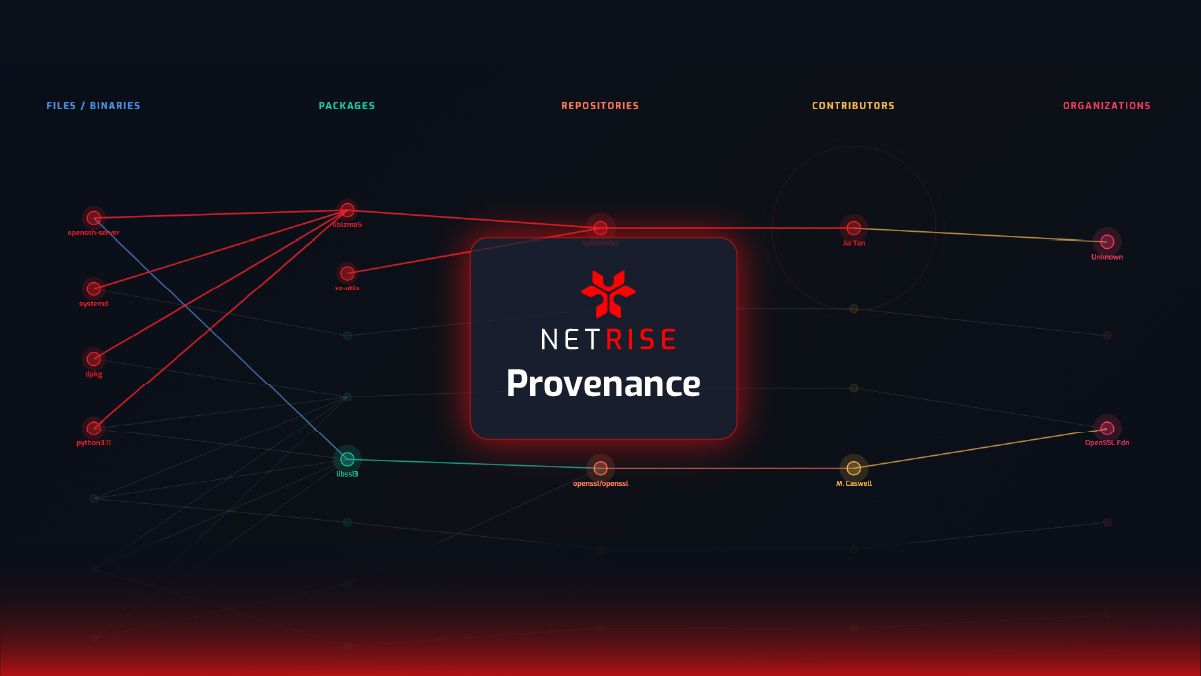
A compromised component rarely lives independently of other code. Provenance follows the package and its maintainers upward, identifying which upstream components call it. Turbine tells you which products you have contain those components..
- Which systems are hit — the moment a component is flagged, the products and apps carrying it are named.
- Whether the project's still alive — active maintenance, or a repository drifting toward abandonment with no one left to patch it.
- Who stands behind the code — which maintainers and organizations own it, the regions they work from, and whether any appear in threat reporting.
The scale behind that answer:
- 3M+open-source repositories under continuous watch
- 10M+packages traced back to their upstream repositories
- 100M+contributors mapped to the organizations and regions behind them
Financial Services Results You Can Measure
Identify every system carrying a newly disclosed vulnerability within minutes, not weeks.
Assess vendor software and M&A targets on evidence, before they reach production.
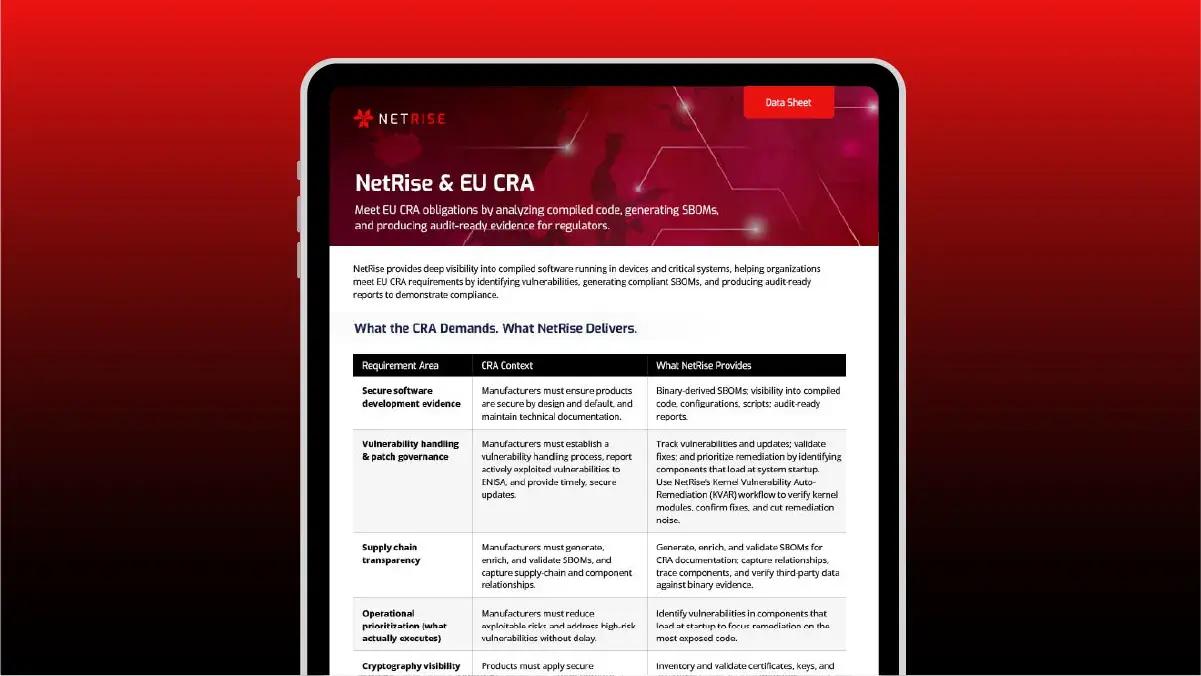
Produce audit-ready evidence aligned with PCI DSS 4.0, NYDFS, SEC Cybersecurity Rules, FFIEC, the NAIC Model Law, and GDPR/CCPA.
Prove what ships in the banking apps and internal tools your own developers build, before they reach production.
What's Inside the Software Your Institution Runs?
A newly disclosed vulnerability sitting inside a core banking module is an outage waiting for a news cycle. Find it first.
Frequently Asked Questions
What does NetRise do for a bank or insurer?
It analyzes the delivered software — core banking platforms, trading systems, ATMs, payment terminals, and the apps your customers log into. Turbine establishes the contents of the compiled build, including layers beneath the application. Provenance assesses whether the open-source inside can be trusted and, when a component is compromised, identifies which of your platforms inherit it.
Won't our vulnerability scanner already catch this?
A scanner enumerates installed software and matches it against public databases. It stops at the surface of a compiled artifact, so the statically linked libraries inside an ATM image or a payment terminal's firmware are never enumerated at all — and that is frequently where known-exploited risk sits.
Can NetRise evaluate a payment terminal or fintech platform we didn't build?
Yes. Analysis runs against the shipped artifact itself, so a core banking module, an ATM image, or a fintech platform can be evaluated without source code or supplier participation — including during M&A diligence, where a target has no reason to hand over a repository.
A disclosure just landed. How fast can we scope it?
Provenance traces how far the affected component propagates across the products and suppliers around it, and Turbine identifies which of your analyzed systems actually contain it. Scoping becomes a query rather than a week of reconciling spreadsheets.
Which financial regulations does this produce evidence for?
Evidence comes from the software running in your environment, aligned with PCI DSS 4.0, NYDFS, SEC Cybersecurity Rules, FFIEC, and the NAIC Model Law, alongside GDPR/CCPA. It also supports work under EO 14028, DORA, and the EU Cyber Resilience Act where those apply. NetRise supplies the underlying evidence; it does not by itself make an institution compliant.
What about the software our own developers build?
Yes. Provenance evaluates the open-source packages your developers pull in, including ones introduced through AI coding assistants, and stops those that fail your rules before they reach a build. Turbine then analyzes the compiled application — not just the source — and surfaces the components, hard-coded credentials, and keys a source-based test misses.