






VULNERABILITY MANAGEMENT
Vulnerability Management: A Clean Scan Isn't Zero Risk
Your VM scanner reported zero CVEs. That doesn't mean zero risk — it checks installed software against known vulnerabilities, but never opens the compiled software underneath.
NetRise adds evidence your VM program can't get elsewhere: CVEs and non-CVE risk from an accurate SBOM of the compiled software you run — including dependencies no scanner enumerates.
The Challenge
Your Scanner Checks the Install List. It Never Opens the Software.
Vulnerability scanners discover the software a system has installed — versions, running services — and match it against vulnerability feeds. But CVEs, secrets, and other artifacts land in the compiled image itself, beneath that layer, where a scanner never looks.
Where Scanner-Reported Evidence Stops Short
OS & network scanners
Discover a device's installed components and match them to known CVEs, but never unpack the compiled binaries inside devices and appliances — so embedded components stay invisible.
Source SBOMs
Describe what developers intended to ship; if not updated with every build, they decay and can't be checked against the shipped binary.
CPE-based CVE matching
Where a vendor has no CPE entries, CPE-based matching returns nothing for that product — even for known, decade-old CVEs — so a component the scanner never enumerated also can't be matched.
CVE-only prioritization
Ranks by CVSS and patch status, blind to whether a component is reachable or whether an artifact carries non-CVE risk (secrets, keys, misconfigurations).
With NetRise
Evidence Across the Vulnerability Lifecycle
Build a component inventory from the binary image itself. NetRise analyzes the compiled firmware, appliance, and application artifacts you run and identifies the components inside — including the statically linked and embedded dependencies no scanner enumerates, which is where known-exploited risk hides unseen.
Separate what's exposed from what's merely present. Execution-aware reachability filters findings to the components that actually execute on the device, so your team works the highest-priority vulnerabilities instead of every CVE in dormant components.
Catch the exposure that carries no CVE at all. NetRise surfaces hard-coded secrets, keys, certificates, and misconfigurations shipped inside the software — risk a CVE-based scanner will never flag.
When a vulnerability is disclosed, NetRise Provenance first determines which components are affected, then NetRIse Turbine confirms which of your assets actually contain them — so you scope exposure in minutes instead of tracing it by hand.
The Solution
Two Products. One Complete Answer.
NetRise Turbine® verifies what's inside the compiled software you run. NetRise Provenance® evaluates whether the open-source behind it can be trusted. Here's what each answers:
NetRise Turbine
Scanners match the software a system has installed against vulnerability feeds, including enriched threat intelligence. But they never open the compiled binary image — so a component a scanner never discovered can't be matched to any feed. Turbine unpacks the binary and builds the inventory from what actually shipped:
- Why the scanner missed it — A scanner checks a device's installed packages and vets them against vulnerability databases, but it doesn’t have a complete picture of what’s inside the package. Turbine unpacks the binary.
- Is it reachable? — Does a traceable execution path connects a running entry point to the affected component? With Turbine you can prioritize risk that can actually be reached and exploited.
- What non-CVE risk is present? — The secrets, public/private key pairs, and misconfigurations shipped in the artifact that a CVE scan never surfaces.
What that surfaces in real software:
- 2400+vulnerabilities in a brand-new XIoT switch a network scanner doesn't flag
- 6of them on the KEV list, all in the Linux kernel the device runs on — code the vendor shipped but didn't write
- 10how long one high-severity KEV kernel CVE has sat in a device sold as new
NetRise Provenance
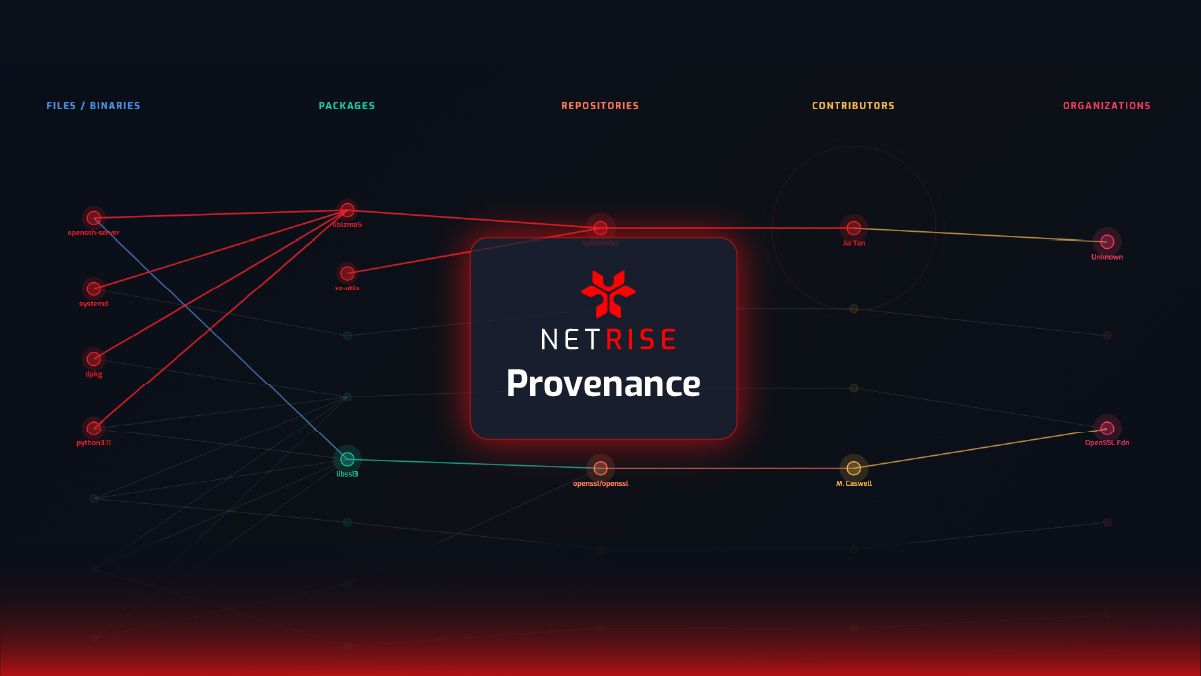
Every vulnerable open-source dependency traces back to a project and the people who maintain it. When one turns risky, Provenance maps how far it reaches and whether the project behind it is still sound.
- How far does it reach? — When a package or contributor turns risky, which of your products and assets inherit the problem.
- Is the project still sound? — Whether the repository behind a component is actively maintained, quietly decaying, or abruptly updated after years of neglect.
- Can you trust the source? — The people and organizations behind the code, where they operate, and whether they're linked to known risk.
What Provenance maps across the supply chain:
- 3M+open-source repositories tracked
- 10M+packages indexed to their upstream sources
- 100M+components marked, with organization and geographic data
Vulnerability Management Results You Can Measure
See more, chase less — filter everything in the binary down to the findings that are actually reachable and exploitable.
Minutes, not weeks — scope which assets contain a disclosed vulnerability across analyzed artifacts.
86 of 116 priority findings closed by four upstream fixes in a federal deployment.
Non-CVE risk surfaced — secrets, key pairs, and misconfigurations a CVE-based scanner never flags.
Ready to Find What Your Scanner Misses?
FAQ
How does NetRise support vulnerability management?
NetRise augments your vulnerability management program with evidence from the compiled software your scanners don't reach. NetRise Turbine identifies the components, known CVEs, and non-CVE risk inside firmware, appliances, and applications; NetRise Provenance evaluates the open-source components behind that software and maps how far a new risk reaches across your assets.
Does NetRise replace my vulnerability scanner?
No. Your scanners stay central — they track patch posture and drive remediation at enterprise scale. NetRise strengthens one dimension: the accuracy and completeness of the software you scan. It doesn't replace your scanners; it finds what they can't reach.
Why do scanners miss vulnerabilities inside compiled software?
A scanner discovers the software a system has installed — packages, services, versions — then cross-references it against vulnerability databases and feeds. But it never unpacks the compiled binary. Statically linked libraries, embedded dependencies, and firmware- and kernel-level code aren't exposed as installed software, so a scanner can't discover them — and real CVEs and non-CVE risk go undetected.
How does NetRise help teams focus on the more important vulnerabilities?
NetRise adds execution context to every finding — kernel auto-remediation, execution-aware reachability, and exploitability filters pinpoint the vulnerabilities that are actually reachable and exploitable. Deep binary analysis surfaces everything inside the artifact, then narrows it to a short list your team can act on. In one federal deployment, four upstream fixes closed 86 of 116 priority findings.
Can NetRise analyze software without the source code?
Yes. NetRise analyzes the compiled software you already run — no source code or vendor cooperation required — so you can validate firmware, appliances, and commercial applications you could never review from source.