






Telecom Software Supply Chain Security
Who Verifies the Code Inside Your Network Equipment?
Equipment makers assemble network software from code their employees didn't write. Operators run it. Both sides need the same thing: proof of what a build actually contains, who stands behind it, and where a compromise travels.
OUTCOMES
Build It or Run it — Same Supply Chain
Evidence from the build, for every release
Evidence from the artifact, for every device
- Ship every release with an SBOM derived from the build, not the manifest.
- Catch build-time deviations before firmware reaches a customer network.
- Scope a compromised dependency across product lines in minutes instead of days.
Telecom Software Supply Chain Security You Can Measure
- Analyze vendor firmware and appliances without source code or vendor cooperation.
- Rank findings by what a live execution path can actually reach, not by severity score.
- Identify every affected network element in minutes when a disclosure lands.
- Do the component versions in the build match the manifest?
- Have we introduced secrets, keys, or misconfigurations that AST tools don't see?
- What do we hand regulators and telecom customers?
- If a package is compromised, which product lines carry it?
Common Questions
- Do we have Log4j, and where?
- Can we verify what a vendor attested to?
- Which devices carry hard-coded or weak credentials?
- Which network elements does this disclosure actually affect?
Package Scanners
Components the build process links in after source review.
Manifest-Derived SBOMs
Agreement with the firmware image a customer receives.
AST Tools
Secrets, keys, and misconfigurations outside the source tree.
Manual Dependency Reviews
Coverage across thousands of packages, or AI-assisted development.
Blind Spots
Vulnerability Management
Anything inside the compiled code running on the device.
Supplier Attestations
Anything beneath the application layer.
Security Questionnaires
Anything past the date they were filled out.
Manual Firmware Analysis
Speed, when a disclosure needs scoping across a fleet.
- Secure software development
- Build verification and deviation detection
- Dependency management and package policy enforcement
- SBOM generation and publication
- Product security and PSIRT response
Common Workflows
- Vendor equipment validation
- Supplier risk assessment
- Firmware and binary analysis
- Network software inventory
- Disclosure response
Evidence from the build, for every release
Telecom Software Supply Chain Security You Can Measure
- Ship every release with an SBOM derived from the build, not the manifest.
- Catch build-time deviations before firmware reaches a customer network.
- Scope a compromised dependency across product lines in minutes instead of days.
Common Questions
- Do the component versions in the build match the manifest?
- Have we introduced secrets, keys, or misconfigurations that AST tools don't see?
- What do we hand regulators and telecom customers?
- If a package is compromised, which product lines carry it?
Blind Spots
Package Scanners
Components the build process links in after source review.
Manifest-Derived SBOMs
Agreement with the firmware image a customer receives.
AST Tools
Secrets, keys, and misconfigurations outside the source tree.
Manual Dependency Reviews
Coverage across thousands of packages, or AI-assisted development.
Common Workflows
- Secure software development
- Build verification and deviation detection
- Dependency management and package policy enforcement
- SBOM generation and publication
- Product security and PSIRT response
Evidence from the artifact, for every device
Telecom Software Supply Chain Security You Can Measure
- Analyze vendor firmware and appliances without source code or vendor cooperation.
- Rank findings by what a live execution path can actually reach, not by severity score.
- Identify every affected network element in minutes when a disclosure lands.
Common Questions
- Do we have Log4j, and where?
- Can we verify what a vendor attested to?
- Which devices carry hard-coded or weak credentials?
- Which network elements does this disclosure actually affect?
Blind Spots
Vulnerability Management
Anything inside the compiled code running on the device.
Supplier Attestations
Anything beneath the application layer.
Security Questionnaires
Anything past the date they were filled out.
Manual Firmware Analysis
Speed, when a disclosure needs scoping across a fleet.
Common Workflows
- Vendor equipment validation
- Supplier risk assessment
- Firmware and binary analysis
- Network software inventory
- Disclosure response
Different Workflows. One Requirement.
Shipping software and accepting it are different jobs with one shared requirement: knowing what a build actually contains, who stands behind that code, and where a compromise travels next.
Request a DemoThe Solution
Two Products. One Complete Answer
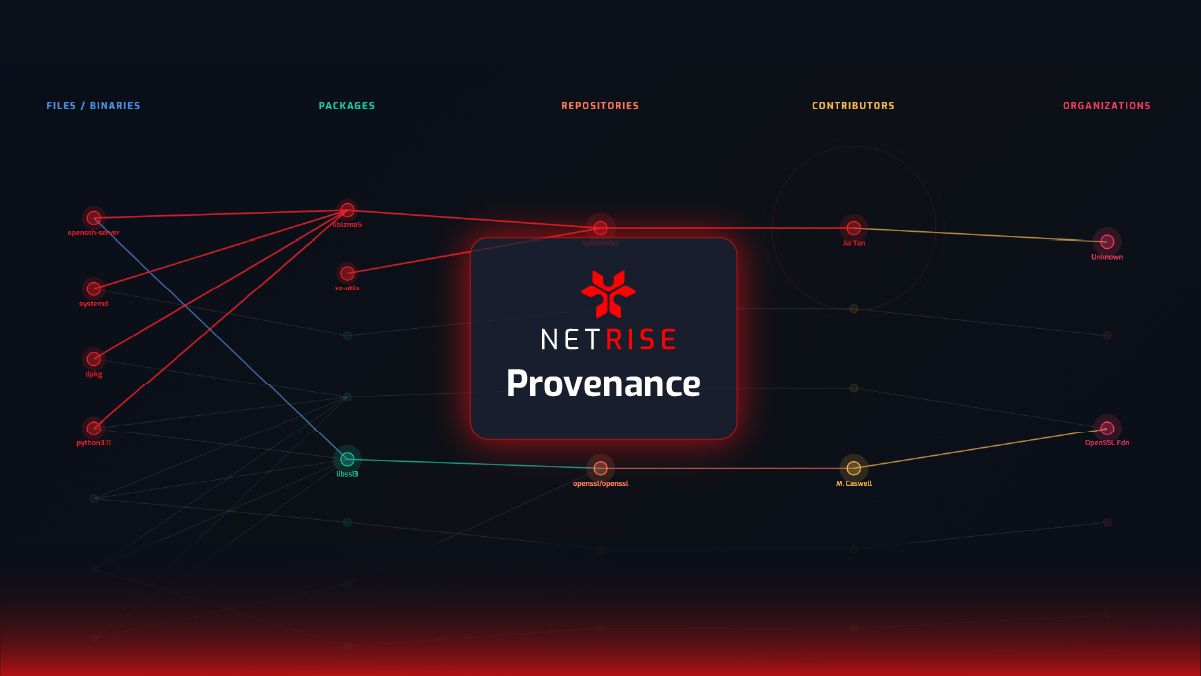
NetRise analyzes the software telecom runs on from both ends of the handoff. NetRise Provenance® determines whether a dependency should be trusted before it enters a build. NetRise Turbine® verifies what a finished firmware image, appliance, or application actually contains — no source code required.
NetRise Provenance
Stop Risky Dependencies Before They Ship
Judge a dependency before it becomes part of a product or a network.
Trace a compromised package outward through the packages and repositories that depend on it, so scoping takes minutes.
Block malicious packages at intake, before a build consumes them.
Hold every dependency to the same trust standard with Package Firewall Manager.
Surface the risk a CVE feed never reports: declining repositories, maintainer churn, unclear stewardship.
NetRise Turbine
Confirm What the Build Actually Produced
Establish the contents of a finished firmware image, appliance, or application from the artifact itself.
Enumerate what's inside compiled telecom software without source code or vendor participation.
Hand operators, customers, and regulators an inventory derived from the build.
Rank by what a live path can reach, and catch the non-CVE risk: secrets, misconfigurations, weak keys.
Confirm the compiled build matches the manifest before it ships.
Together They Deliver Software Supply Chain Security
Provenance assesses whether a dependency deserves trust and follows it outward through the packages, repositories, and maintainers it touches.
Turbine locates those components inside the firmware and applications your organization builds or receives.
Answer, in minutes:
- Are we affected?
- Which products or network elements carry it?
- Which suppliers shipped it?
- What gets remediated first?
Ready to Stop Taking Your Network Software on Faith?
Whether you build telecom equipment or run the network it serves, stop relying on declarations, manifests, and assumptions. Make every software trust decision using evidence from the software itself.
Frequently Asked Questions
What is telecom software supply chain security?
It's the practice of securing the code that reaches a network without anyone in the chain having written it. Equipment makers assemble products from open-source and third-party components; operators deploy those products across core, edge, and customer premises. NetRise approaches it with evidence of what's actually inside the software, whether it can be trusted, and how far risk reaches.
How does NetRise help telecom OEMs and equipment vendors?
Provenance evaluates the dependencies going into a build, including those introduced through AI-assisted development, and holds each one to your trust standard before it's linked in. Turbine then analyzes the compiled build rather than the source, so component versions can be checked against the manifest and build-time deviations caught before firmware reaches a customer. It also surfaces the risk AST tools sit outside of — hard-coded secrets, weak public and private keys, misconfigurations, and legacy components in core platforms where source may no longer exist.
How does NetRise help network operators?
NetRise analyzes the compiled software across network infrastructure, OSS/BSS platforms, 5G core components, edge systems, and customer premises equipment. Turbine confirms what a vendor's device actually runs, including components beneath the application layer. Provenance judges whether the open-source inside can be trusted and maps how far a new compromise reaches across the network.
Can NetRise analyze network equipment without the source code?
Yes. Analysis runs against the shipped artifact itself, so firmware, appliances, and network applications can be evaluated without source code or vendor participation — which matters most for the legacy equipment nobody can produce source for anymore.
Do we need both products, or does one cover telecom?
They answer different questions. Provenance works on open-source dependency risk — origin, maintainers, repository health, and how far a compromise propagates. Turbine works on the compiled artifact, establishing what a shipped firmware image or appliance actually contains. Equipment makers typically use both; operators often start with Turbine and add Provenance as vendor dependency risk becomes a procurement question.
Which telecom regulations does NetRise produce evidence for?
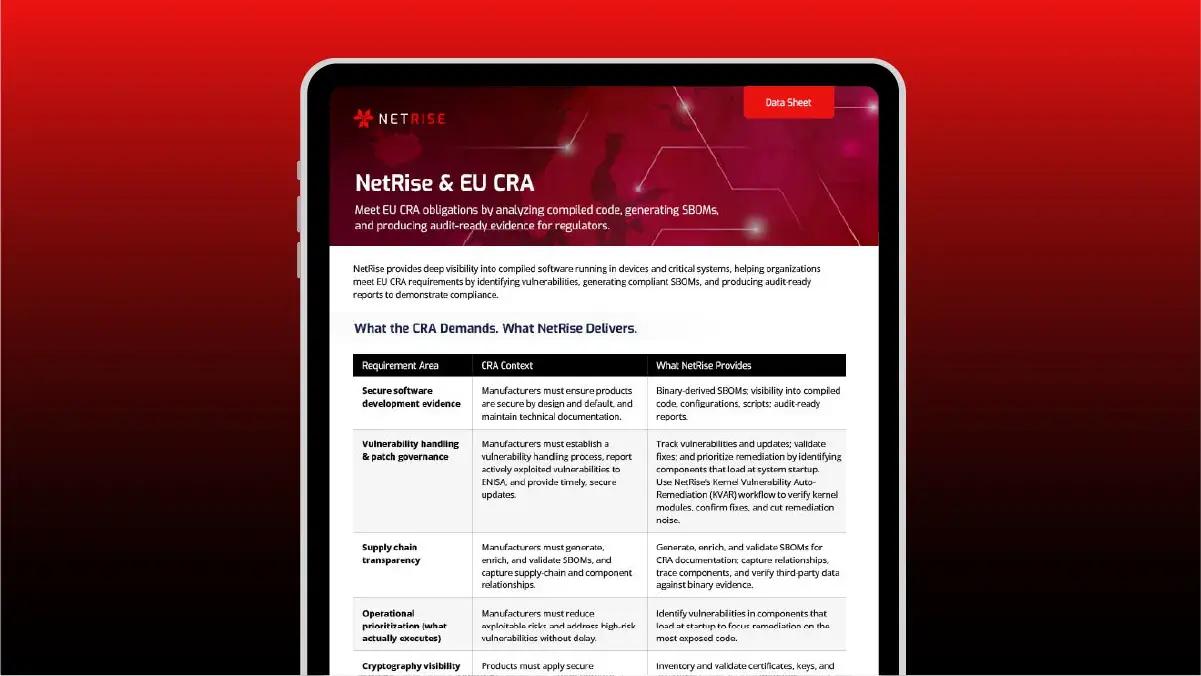
Evidence comes from the software actually running in your network or shipping in your products, which supports obligations under FCC requirements, NIST CSF 2.0, EO 14028, the EU CRA, and 3GPP and 5G/6G standards. NetRise supplies the underlying evidence; it does not by itself make an organization compliant.